advertisements
|

|
How a fine artist gave shape to a space shuttle's new towering exhibit
November 13, 2026 — Natalie Rosen is not the type of specialist you immediately associate with being one of the key people behind the technically-challenging new exhibit of the space shuttle Endeavour.
She is not a former NASA technician or engineer, as many of her colleagues for the past several years were, nor is she a curator or conservator. Before this job, she had no experience working on any type of aircraft or spacecraft, as now fills the new Samuel Oschin Air and Space Center, an extension to the California Science Center, opening in Los Angeles on Friday (Nov. 13).
Without her expertise and artistry, however, the largest component of Endeavour's "stack" would look nothing like it did when the shuttle was flying.
"My background is in the fine arts. I have my bachelor's and my master's in fine arts from Cal State Long Beach," Rosen said in an interview with collectSPACE. "When I came in on this project, they were looking for a sculptor, and I had been sculpting."
Rosen had been working with mixed media for her thesis project and had experience sculpting foam. As it happened, the California Science Center had a lot of foam in need of shaping.
ET-94
For those not familiar, the space shuttle was assembled from three primary launch components. The orbiter and its solid rocket boosters were reusable, given the time needed to inspect, service and, in the case of the solid fuel motors, refurbish and refill, between flights.
The 154-foot-tall (47-meter) external tank was the only major part of the stack that was disposed of with each launch. After providing the propellant for the orbiter's three main engines, the tank was jettisoned and it disintegrated while reentering the atmosphere.
To protect the orbiter from the extreme cold temperatures of the cryogenic liquid oxygen and liquid hydrogen that the external tank was filled with and to keep the propellant and oxidizer from boiling off too quickly, the ET was covered in insulating foam. (Some of that foam became liberated during ascent and was what caused the loss of the space shuttle Columbia and its crew in 2003.)
The only flight-worthy tank to remain at the end of the program was ET-94. A so-called lightweight tank, it was built at a time when NASA was transitioning to use a super lightweight model and therefore was set aside. Originally slated to support a science mission on Columbia, it instead became a testbed after the tragedy, having its foam stripped off and tested to better understand what had happened.
After the program ended, NASA donated ET-94 to the California Science Center. It arrived by way of a transoceanic barge and a road trip and then sat at Exposition Park for nearly a decade.
"So much of the foam on the ET had been dissected and removed during its time as a test article that they [the California Science Center] were trying to figure out how to put it back on and blend it in to the original foam in a convincing way," said Rosen.
'Orange' peel
There has been a long-standing debate among shuttle enthusiasts and modelers as to exactly what color the external tank is and the answer resides in the foam.
"It's orange. It's cream. It's burnt sienna. It just depends on the original foam, when you're seeing it and how it's aging. Because it starts as a kind of very ice cream white almost color, and then depending on how long it sits out in the Sun, it turns orange," said Rosen.
By the time she had come on staff, the decision for the most part had already been made. Dennis Jenkins, the leader of the Endeavour project, had blended a special paint called "ET Orange" that was used to cover the existing acreage "bumpy" foam. Separately, a mocha-like color was picked out for the intertank.
"And then the latest foam to be installed, which would have looked the newest on all of the closeout hardware — the feed lines, the ice frost ramps, the flanges around the intertank and the intertank rings — those were all the lightest color that we custom mixed. That was what we called the ice cream color," Rosen said.
It was not only about color matching, though. For multiple reasons, the original aerospace-grade foam could not be used, so a commercial substitute had to be found that could match what Rosen described as the "orange peel."
"If you look at the tank very closely, there's this bumpy texture, and there is a pattern from the original manufacturing and how it was sprayed on. There's this overlapping line, a subtle-like stripe to it," she said.
Replicating that pattern was not easy.
"There was a lot of trial and error in the beginning of what we could do to try and get it to match what was already there," Rosen told collectSPACE. "We tried taking impressions off of the real foam and making molds and casting, but that didn't really work. I then suggested we put in a dense urethane, like plain urethane foam, and I hand sculpt the top of it to match what was around it. That ended up becoming the best solution for fixing the acreage foam that had an orange peel-like texture."
Jenkins, who had worked as a space shuttle engineer and led NASA's delivery of the orbiters to their museum homes, had high praise for Rosen and her work.
"She had to come up with a lot of new processes because we couldn't apply foam the same way they did at Michoud. It's not flightworthy by any means, but just coming up with how to make it look real took a lot of imagination on her part and she was pretty much a one-woman show for most of it," he said.
In the vertical
Some of the repair work to the external tank was finished before it was lifted by crane into the Samuel Oschin Air and Space Center and mated with the boosters and Endeavour. From that point forward, Rosen had to climb scaffolding to get to her worksites.
"it's definitely the largest art project I've ever worked on, and I mean I touched every inch of it," Rosen said. "Once it went vertical, I was going up and down stairs. Probably the scariest was the point in the scaffolding where it just became ladders. So I had to be very, very careful and calculated in what I was doing."
Even after the scaffolding was removed in preparation for the museum opening, Rosen's ascents were not over. A couple weeks ago, she had to install a final component on the aft dome of the liquid hydrogen tank and to reach that, she needed to be in a scissor lift.
Now that the entire Endeavour stack is ready for its public debut, Rosen is not parting ways with the California Science Center. The work she did on ET-94 has launched her career into a new frontier.
"In this last year, I have been working on different artifacts with the team. I have been helping leading up to the opening. I've helped in ways with the different aircraft, with their assembly, their disassembly and reassembly. I've done some repairs in certain areas. I've worked with our satellite and probe collection to do repairs and also contacted specialists outside of my realm to clean and repair thermal blankets," said Rosen.
"So I'm planning on staying with the museum for now. They've offered me another position and I'm happy to stay," she said.
The California Science Center's Samuel Oschin Air and Space Center opens to the public at 11:15 a.m. PST on Friday (Nov. 13), following a private ribbon cutting. General admission is free, but timed entry tickets are needed for the Samuel Oschin Air and Space Center due to the high demand. Reservations can be made online or at 213-744-2019. |
|
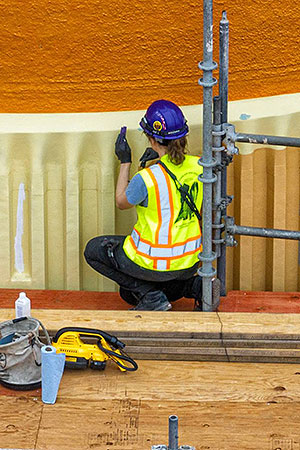
Sculptor Natalie Rosen, poised atop a high platform in 2024, works on touch-ups to the foam on the forward intertank stringers for the external tank on vertical display with the space shuttle Endeavour in the Samuel Oschin Air and Space Center in Los Angeles. (CSC)
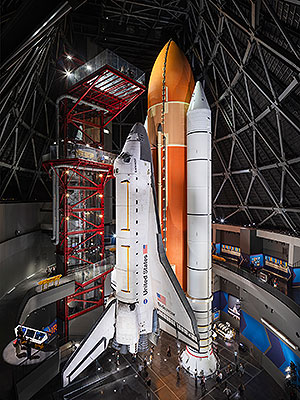
The only fully-authentic display of a space shuttle in its launch configuration opens ot the public at the California Science Center in Los Angeles on Nov. 13, 2026. (CSC / ZGF Architects/Mike Kelley)
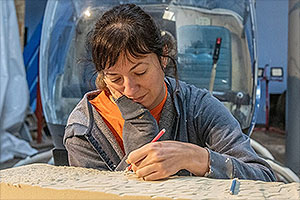
Restoration specialist Natalie Rosen sculpts foam to be installed on space shuttle Endeavour's solid rocket boosters in 2024. (CSC)
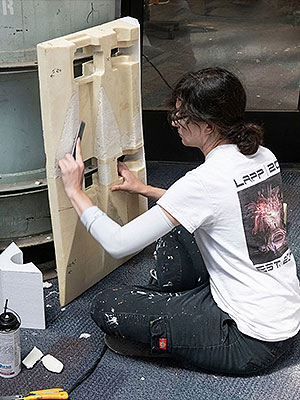
Natalie Rosen shapes a foam ice frost ramp that was later installed in a series of ramps along the outside length of ET-94. (CSC)
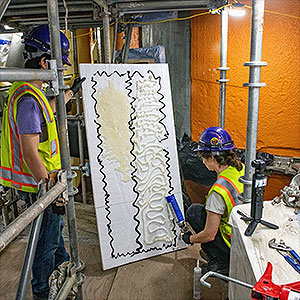
External tank restoration specialist Natalie Rosen applies close-out foam on ET-94's aft longeron area. (California Science Center) |
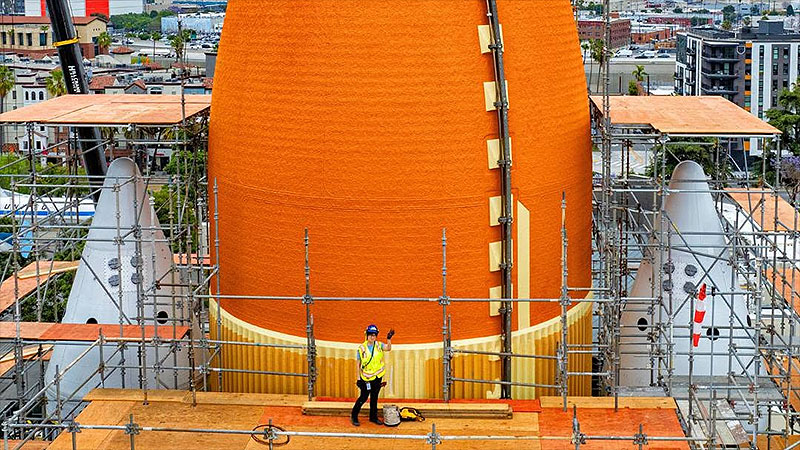
Standing atop scaffolding in June 2024, fine art sculptor Natalie Rosen waves in front of ET-94, the external tank that she restored and is now debuting on display with the space shuttle Endeavour in the California Science Center's new Samuel Oschin Air and Space Center in Los Angeles. (CSC) |
|

© collectSPACE. All rights reserved.
|
|
|
|