September 25, 2007 — Fifty years ago from October 4, the horizon changed forever. What started as a science experiment, quickly evolved into a political competition, and then drove men to the Moon in fewer than 12 years.
Of course, today it seems so simple. Several thousands of satellites later, when a private company can launch a satellite into space, to say nothing of the 463 people who have been there and back, a 23-inch, 184-pound beeping ball could almost be overlooked. Almost.
The Earth's first man-made moon was in orbit for only 57 days but its influence can still be felt 50 years later. The United States' civilian space agency, NASA can credit its founding, three days shy of one year later, to the political reaction to Sputnik 1. Sputnik's now familiar "beep, beep, beep" was the original satellite radio. And the race among nations that it set into motion led to the cooperation seen today on-board the international space station.
Sputnik 1 was completely destroyed when it reentered the atmosphere on January 4, 1958. What remains today are the handful of backup units, vintage and modern replicas, and less tangible reminders of the now iconic quad-spiked sphere.
As a tribute to the five decades of space exploration that Sputnik trailblazed, collectSPACE presents a countdown of the "top ten" Sputniks, one per day, culminating on the 50th anniversary, October 4, 2007. The list begins with...
#10. World's Most Popular Sputnik (Replica)
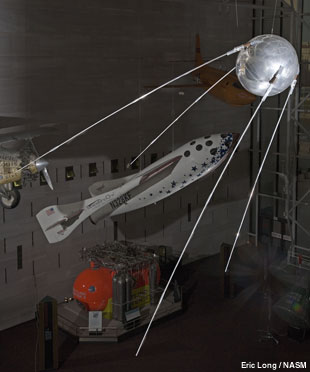
Sputnik 1 replica on display in the Milestones of Flight at the Smithsonian's National Air and Space Museum. |
Where else would you expect to find the world's most popular Sputnik than the world's most popular museum?
The Smithsonian's National Air and Space Museum in Washington, D.C. displays a full-size Sputnik hanging in its Milestones of Flight Gallery, near other historic air and spacecraft, including Lindbergh's Spirit of St. Louis, Apollo 11's Columbia and most recently, SpaceShipOne.
For the anniversary, curators have moved Sputnik and a model of the first U.S. satellite, Explorer I, to hang lower to the floor and more central to the gallery.
"Sputnik looks a whole lot bigger," said Cathleen Lewis, curator of international space programs, of the satellite's new location.
Loaned by the Soviet Academy of Sciences in 1976, the museum's Sputnik is empty, there are no instruments or moving parts. The replica's history is unknown, as there are no indications to its provenance.
There are other museums with other Sputniks (some of which will appear later on this countdown), on display in countries around the world. From Le Bourget, France to Prague, Czech Republic to London, England, there are, by some counts, as many as 40 Sputniks. Compared to the Smithsonian's, some are more complete, and some are more historic.
With over five million visitors per year however, there is no more popular a Sputnik than the replica at the National Air and Space Museum.
Learn more: