November 26, 2026 — An American multimedia artist who found his inspiration in the engineering behind the Apollo moon landings has now seen his art adapted as a special installation aboard a spacecraft.
Tony Oursler created "Star*(life)" as a projection mapping show for Luci d'Artista, an open-air light festival now underway in Turin, Italy. In celebration, aerospace manufacturer Thales Alenia Space, together with Politecnico di Torino university and Northrop Grumman, worked with the event's organizers to fly an adaptation of Star*(life) as a light fixture cover on the next Cygnus vehicle scheduled to deliver supplies to the International Space Station.
"This initiative perfectly highlights how space technology can connect with other fields of knowledge and human creativity. It also underlines the importance of the Cygnus program, whose contribution extends well beyond cargo transportation," said Annamaria Piras, head of low Earth orbit programs at Thales Alenia Space.
"Every mission supports the continuity of human presence in orbit, enabling scientific research and offering astronauts the resources they need to live and work aboard the ISS," she said.
The NG-25 Cygnus, which is named "S.S. James Lovell" after the Gemini and Apollo astronaut, is scheduled to launch on Sunday (Nov. 29) on a SpaceX Falcon 9 rocket from Florida, carrying Oursler's Star*(life) along with 11,000 pounds of scientific investigations, cargo and supplies for the station's Expedition 75 crew.
From light to light cover
In its festival format, Oursler's Star*(life) uses immersive video projection across several buildings at Politecnico to "travel through the imagination ... with dreamlike and grotesque characters [moving] through galaxies and planets, subverting conventional notions of space and time," according to the installation's description.
"I remember listening to the radio when the first footsteps imprinted the dusty surface of the moon in 1969. It was seen as the single greatest achievement of creative collaboration up to that moment in human history," wrote Oursler on his website. "Within that moment, there was a mix of poetry and engineering: a collective act of imagination had become a physical reality, and humanity had entered a new paradigm."
"The heavens have always generated narratives, gods, and predictions by which we trace our fears, aspirations, and desires. Wandering asteroids from other galaxies arrive to reveal within its hardened core [sic], peptides, precursors to DNA and water trapped within. Seeds of life are everywhere. The universe offers material evidence, but imagination gives that evidence meaning," he wrote. "As we look upward to navigate our mundane lives, it turns out that the ground we stand upon is made of stars — indeed, the same material scattered across the universe. This recognition collapses the distance between the cosmic and the personal. We are not merely observers of the universe; we are made from it."
The Thales Alenia Space team, which manufactures the Cygnus pressurized cargo modules for Northrop Grumman, worked to translate Oursler's composition into an embroidered image, which was then applied as a patch to the Teflon-coated silk cover protecting one of the lighting units inside Cygnus.
"One of the main challenges was combining materials developed for different applications, each with specific characteristics and tolerances, while ensuring their compatibility and performance," said Donata Valletti, lighting product manager at Thales Alenia Space, who was directly involved in the development of the project. "This required careful engineering and validation to meet the stringent requirements of the space environment, while preserving the artistic vision behind the project."
"It has been a rewarding experience for our team to provide our technical expertise to such a unique initiative, bringing together innovation, engineering and creativity in an entirely new way," she said.
The space-bound Star*(life) is described as "a concise representation of a star endowed with DNA, merging the human dimension with the cosmic one and creating a short circuit where the infinitely small overlaps with, and even becomes interchangeable with, the infinitely large." According to Oursler, "the piece makes visible how lives are increasingly tied to exploration beyond Earth."
Artistic transformation
Star*(life) is not the first artwork to be launched into space, though it is something new for the interior of the Cygnus cargo module.
"For viewers on the ground, the sculpture is a striking piece of contemporary art. For the team behind NG 25, it is also a symbol of their decades of innovation reaching humanity's farthest frontiers," reads a page dedicated to the project on Northrop Grumman's website. "As the installation travels to the ISS, it transforms Cygnus from a pure logistics vehicle into a carrier of culture, connecting everyday life on Earth with humanity's expanding presence in orbit."
"The same systems that move cargo through space can also move ideas, stories and cultural touchstones," the website reads. "The decision to make room for art alongside experiments points to a broader vision: a future in which space is not just a frontier for data and technology, but a place where human culture can take root."
Thales Alenia Space also welcomed the opportunity to "bring together innovation, engineering and creativity in an entirely new way."
"With Cygnus NG-25, our technological expertise will once again help support life in space, while carrying a small but meaningful sense of the creativity that makes human exploration even more inspiring," said Piras. |
|
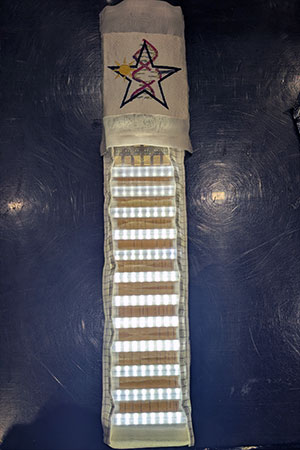
Northrop Grumman's Cygnus NG-25 spacecraft will embark to the International Space Station carrying supplies, scientific experiments and a piece of contemporary art. (Thales Alenia Space)
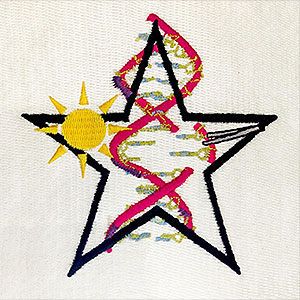
The Star*(life) launching on a light fixture aboard Cygnus is "a concise representation of a star endowed with DNA, merging the human dimension with the cosmic one and creating a short circuit where the infinitely small overlaps with, and even becomes interchangeable with, the infinitely large." (Northrop Grumman)
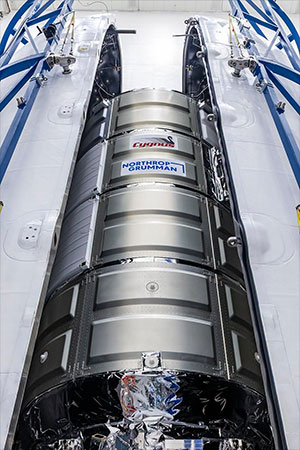
Northrop Grumman's NG-25 Cygnus spacecraft, the S.S. James Lovell, is seen being encapsulated in its fairing for launch atop a SpaceX Falcon 9 rocket from Cape Canaveral, Florida. (SpaceX) |