Posts: 56890 From: Houston, TX Registered: Nov 1999
posted 05-24-2005 02:28 PM
NASA release
Voyager Enters Solar System's Final Frontier
NASA's Voyager 1 spacecraft has entered the solar system's final frontier. It is entering a vast, turbulent expanse, where the sun's influence ends and the solar wind crashes into the thin gas between stars.
"Voyager 1 has entered the final lap on its race to the edge of interstellar space," said Dr. Edward Stone, Voyager project scientist at the California Institute of Technology in Pasadena. Caltech manages NASA's Jet Propulsion Laboratory in Pasadena, which built and operates Voyager 1 and its twin, Voyager 2.
In November 2003, the Voyager team announced it was seeing events unlike any in the mission's then 26-year history. The team believed the unusual events indicated Voyager 1 was approaching a strange region of space, likely the beginning of this new frontier called the termination shock region. There was considerable controversy over whether Voyager 1 had indeed encountered the termination shock or was just getting close.
The termination shock is where the solar wind, a thin stream of electrically charged gas blowing continuously outward from the sun, is slowed by pressure from gas between the stars. At the termination shock, the solar wind slows abruptly from a speed that ranges from 700,000 to 1.5 million mph and becomes denser and hotter. The consensus of the team is Voyager 1, at approximately 8.7 billion miles from the sun, has at last entered the heliosheath, the region beyond the termination shock.
Predicting the location of the termination shock was hard, because the precise conditions in interstellar space are unknown. Also, changes in the speed and pressure of the solar wind cause the termination shock to expand, contract and ripple.
The most persuasive evidence that Voyager 1 crossed the termination shock is its measurement of a sudden increase in the strength of the magnetic field carried by the solar wind, combined with an inferred decrease in its speed. This happens whenever the solar wind slows down.
In December 2004, the Voyager 1 dual magnetometers observed the magnetic field strength suddenly increasing by a factor of approximately 2 1/2, as expected when the solar wind slows down. The magnetic field has remained at these high levels since December. NASA's Goddard Space Flight Center, Greenbelt, Md., built the magnetometers.
Voyager 1 also observed an increase in the number of high-speed electrically charged electrons and ions and a burst of plasma wave noise before the shock. This would be expected if Voyager 1 passed the termination shock. The shock naturally accelerates electrically charged particles that bounce back and forth between the fast and slow winds on opposite sides of the shock, and these particles can generate plasma waves.
"Voyager's observations over the past few years show the termination shock is far more complicated than anyone thought," said Dr. Eric Christian, Discipline Scientist for the Sun-Solar System Connection research program at NASA Headquarters, Washington.
The result is being presented today at a press conference in the Morial Convention Center, New Orleans, during the 2005 Joint Assembly meeting of Earth and space science organizations.
Robert Pearlman Editor
Posts: 56890 From: Houston, TX Registered: Nov 1999
posted 08-15-2006 11:25 PM
NASA/JPL release
Voyager 1: 'The Spacecraft That Could' Hits New Milestone
Voyager 1, already the most distant human-made object in the cosmos, reaches 100 astronomical units from the sun on Tuesday, August 15 at 5:13 p.m. Eastern time (2:13 p.m. Pacific time). That means the spacecraft, which launched nearly three decades ago, will be 100 times more distant from the sun than Earth is.
In more common terms, Voyager 1 will be about 15 billion kilometers (9.3 billion miles) from the sun. Dr. Ed Stone, Voyager project scientist and the former director of NASA's Jet Propulsion Laboratory in Pasadena, Calif., says the Voyager team always predicted that the spacecraft would have enough power to last this long.
"But what you can't predict is that the spacecraft isn't going to wear out or break. Voyager 1 and 2 run 24 hours a day, seven days a week, but they were built to last," Stone said. The spacecraft have really been put to the test during their nearly 30 years of space travel, flying by the outer planets, and enduring such challenges as the harsh radiation environment around Jupiter.
The spacecraft are traveling at a distance where the sun is but a bright point of light and solar energy is not an option for electrical power. The Voyagers owe their longevity to their nuclear power sources, called radioisotope thermoelectric generators, provided by the Department of Energy.
Voyager 1 is now at the outer edge of our solar system, in an area called the heliosheath, the zone where the sun's influence wanes. This region is the outer layer of the 'bubble' surrounding the sun, and no one knows how big this bubble actually is. Voyager 1 is literally venturing into the great unknown and is approaching interstellar space. Traveling at a speed of about one million miles per day, Voyager 1 could cross into interstellar space within the next 10 years.
"Interstellar space is filled with material ejected by explosions of nearby stars," Stone said. "Voyager 1 will be the first human-made object to cross into it."
Voyager Project Manager Ed Massey of JPL says the survival of the two spacecraft is a credit to the robust design of the spacecraft, and to the flight team, which is now down to only 10 people. "But it's these 10 people who are keeping these spacecraft alive. They're very dedicated. This is sort of a testament to them, that we could get all this done."
Between them, the two Voyagers have explored Jupiter, Uranus, Saturn and Neptune, along with dozens of their moons. In addition, they have been studying the solar wind, the stream of charged particles spewing from the sun at nearly a million miles per hour.
Robert Pearlman Editor
Posts: 56890 From: Houston, TX Registered: Nov 1999
posted 08-20-2007 11:51 AM
NASA release
Pioneering NASA Spacecraft Mark Thirty Years of Flight
NASA's two venerable Voyager spacecraft are celebrating three decades of flight as they head to interstellar space. Their ongoing odysseys mark an unprecedented and historic accomplishment.
Voyager 2 launched on Aug. 20, 1977, and Voyager 1 launched on Sept. 5, 1977. They continue to return information from distances more than three times farther away than Pluto.
"The Voyager mission is a legend in the annals of space exploration. It opened our eyes to the scientific richness of the outer solar system, and it has pioneered the deepest exploration of the sun's domain ever conducted," said Alan Stern, associate administrator for NASA's Science Mission Directorate, Washington. "It's a testament to Voyager's designers, builders and operators that both spacecraft continue to deliver important findings more than 25 years after their primary mission to Jupiter and Saturn concluded."
During their first dozen years of flight, the spacecraft made detailed explorations of Jupiter, Saturn, and their moons, and conducted the first explorations of Uranus and Neptune. These planets were previously unknown worlds. The Voyagers returned never-before-seen images and scientific data, making fundamental discoveries about the outer planets and their moons. The spacecraft revealed Jupiter's turbulent atmosphere, which includes dozens of interacting hurricane-like storm systems, and erupting volcanoes on Jupiter's moon Io. They also showed waves and fine structure in Saturn's icy rings from the tugs of nearby moons.
For the past 19 years, the twin Voyagers have been probing the sun's outer heliosphere and its boundary with interstellar space. Both Voyagers remain healthy and are returning scientific data 30 years after their launches.
Voyager 1 currently is the farthest human-made object at a distance from the sun of about 9.7 billion miles. Voyager 2 is about 7.8 billion miles from the sun. Originally designed as a four-year mission to Jupiter and Saturn, the Voyager tours were extended because of their successful achievements and a rare planetary alignment. The two-planet mission eventually became a four-planet grand tour. After completing that extended mission, the two spacecraft began the task of exploring the outer heliosphere.
"The Voyager mission has opened up our solar system in a way not possible before the Space Age," said Edward Stone, Voyager project scientist at the California Institute of Technology, Pasadena, Calif. "It revealed our neighbors in the outer solar system and showed us how much there is to learn and how diverse the bodies are that share the solar system with our own planet Earth."
In December 2004, Voyager 1 began crossing the solar system's final frontier. Called the heliosheath, this turbulent area, approximately 8.7 billion miles from the sun, is where the solar wind slows as it crashes into the thin gas that fills the space between stars. Voyager 2 could reach this boundary later this year, putting both Voyagers on their final leg toward interstellar space.
Each spacecraft carries five fully functioning science instruments that study the solar wind, energetic particles, magnetic fields and radio waves as they cruise through this unexplored region of deep space. The spacecraft are too far from the sun to use solar power. They run on less than 300 watts, the amount of power needed to light up a bright light bulb. Their long-lived radioisotope thermoelectric generators provide the power.
"The continued operation of these spacecraft and the flow of data to the scientists is a testament to the skills and dedication of the small operations team," said Ed Massey, Voyager project manager at NASA's Jet Propulsion Laboratory in Pasadena, Calif. Massey oversees a team of nearly a dozen people in the day-to-day Voyager spacecraft operations.
The Voyagers call home via NASA's Deep Space Network, a system of antennas around the world. The spacecraft are so distant that commands from Earth, traveling at light speed, take 14 hours one-way to reach Voyager 1 and 12 hours to reach Voyager 2. Each Voyager logs approximately 1 million miles per day.
Each of the Voyagers carries a golden record that is a time capsule with greetings, images and sounds from Earth. The records also have directions on how to find Earth if the spacecraft is recovered by something or someone.
NASA's next outer planet exploration mission is New Horizons, which is now well past Jupiter and headed for a historic exploration of the Pluto system in July 2015.
Robert Pearlman Editor
Posts: 56890 From: Houston, TX Registered: Nov 1999
posted 05-07-2010 08:19 AM
NASA/Jet Propulsion Laboratory release
Engineers Diagnosing Voyager 2 Data System
Engineers have shifted NASA's Voyager 2 spacecraft into a mode that transmits only spacecraft health and status data while they diagnose an unexpected change in the pattern of returning data. Preliminary engineering data received on May 1 show the spacecraft is basically healthy, and that the source of the issue is the flight data system, which is responsible for formatting the data to send back to Earth. The change in the data return pattern has prevented mission managers from decoding science data.
The first changes in the return of data packets from Voyager 2, which is near the edge of our solar system, appeared on April 22. Mission team members have been working to troubleshoot and resume the regular flow of science data. Because of a planned roll maneuver and moratorium on sending commands, engineers got their first chance to send commands to the spacecraft on April 30. It takes nearly 13 hours for signals to reach the spacecraft and nearly 13 hours for signals to come down to NASA's Deep Space Network on Earth.
Voyager 2 launched on August 20, 1977, about two weeks before its twin spacecraft, Voyager 1. The two spacecraft are among the most distant human-made objects, out at the edge of the heliosphere, the bubble the sun creates around the solar system. Mission managers expect Voyager 1 to leave our solar system and enter interstellar space in the next five years or so, with Voyager 2 on track to enter interstellar space shortly afterward. Voyager 1 is in good health and performing normally.
"Voyager 2's initial mission was a four-year journey to Saturn, but it is still returning data 33 years later," said Ed Stone, Voyager project scientist at the California Institute of Technology in Pasadena. "It has already given us remarkable views of Uranus and Neptune, planets we had never seen close-up before. We will know soon what it will take for it to continue its epic journey of discovery."
The original goals for the two Voyager spacecraft were to explore Jupiter and Saturn.
As part of a mission extension, Voyager 2 also flew by Uranus in 1986 and Neptune in 1989, taking advantage of a once-in-176-year alignment to take a grand tour of the outer planets. Among its many findings, Voyager 2 discovered Neptune's Great Dark Spot and 450-meter-per-second (1,000-mph) winds. It also detected geysers erupting from the pinkish-hued nitrogen ice that forms the polar cap of Neptune's moon Triton. Working in concert with Voyager 1, it also helped discover actively erupting volcanoes on Jupiter's moon Io, and waves and kinks in Saturn's icy rings from the tugs of nearby moons.
Voyager 2 is about 13.8 billion kilometers, or 8.6 billion miles, from Earth. Voyager 1 is about 16.9 billion kilometers (10.5 billion miles) away from Earth.
The Voyagers were built by JPL, which continues to operate both spacecraft. Caltech manages JPL for NASA.
Robert Pearlman Editor
Posts: 56890 From: Houston, TX Registered: Nov 1999
One flip of a bit in the memory of an onboard computer appears to have caused the change in the science data pattern returning from Voyager 2, engineers at NASA's Jet Propulsion Laboratory said on Monday, May 17. A value in a single memory location was changed from a 0 to a 1.
On May 12, engineers received a full memory readout from the flight data system computer, which formats the data to send back to Earth. They isolated the one bit in the memory that had changed, and they recreated the effect on a computer at JPL. They found the effect agrees with data coming down from the spacecraft. They are planning to reset the bit to its normal state on Wednesday, May 19.
Robert Pearlman Editor
Posts: 56890 From: Houston, TX Registered: Nov 1999
posted 05-25-2010 03:56 AM
NASA/Jet Propulsion Laboratory release
Update: May 24, 2010 at 5:30 p.m. PDT
Engineers successfully reset a computer onboard Voyager 2 that caused an unexpected data pattern shift, and the spacecraft resumed sending properly formatted science data back to Earth on Sunday, May 23. Mission managers at NASA's Jet Propulsion Laboratory in Pasadena, Calif., had been operating the spacecraft in engineering mode since May 6. They took this action as they traced the source of the pattern shift to the flip of a single bit in the flight data system computer that packages data to transmit back to Earth. In the next week, engineers will be checking the science data with Voyager team scientists to make sure instruments onboard the spacecraft are processing data correctly.
Update: May 20, 2010 at 6:00 p.m. PDT
Engineers have successfully corrected the memory on NASA's Voyager 2 spacecraft by resetting a computer bit that had flipped. Reset commands were beamed up to the spacecraft yesterday, Wed., May 19, and engineering data received today confirm that the reset was successful. The Voyager team will continue monitoring the engineering data, and if the bit remains reset, commands to switch to the science data mode will be beamed up to Voyager 2 on Sat., May 22. Receipt of science data would then resume on Sun., May 23.
Robert Pearlman Editor
Posts: 56890 From: Houston, TX Registered: Nov 1999
posted 06-28-2010 10:45 AM
NASA/Jet Propulsion Laboratory release
Voyager 2 completes 12,000 days of continuous operations
On June 28, 2010, Voyager 2 will have been operating continuously for 12,000 days since its launch on August 5, 1977.
For nearly 33 years, the venerable spacecraft has been returning unprecedented data about the giant outer planets, the properties of the solar wind between and beyond the planets and the interaction of the solar wind with interstellar winds in the heliosheath. Having traveled more than 21 billion kilometers on its winding path through the planets toward interstellar space, the spacecraft is now nearly 14 billion kilometers from the sun. Traveling at the speed of light, a signal from the ground takes about 12.8 hours to reach the spacecraft.
Voyager 1 will reach this milestone on July 13 after having traveled more than 22 billion kilometers. Voyager 1 is currently more than 17 billion kilometers from the Sun.
Robert Pearlman Editor
Posts: 56890 From: Houston, TX Registered: Nov 1999
The 33-year odyssey of NASA's Voyager 1 spacecraft has reached a distant point at the edge of our solar system where there is no outward motion of solar wind.
Now hurtling toward interstellar space some 17.4 billion kilometers (10.8 billion miles) from the sun, Voyager 1 has crossed into an area where the velocity of the hot ionized gas, or plasma, emanating directly outward from the sun has slowed to zero. Scientists suspect the solar wind has been turned sideways by the pressure from the interstellar wind in the region between stars.
The event is a major milestone in Voyager 1's passage through the heliosheath, the turbulent outer shell of the sun's sphere of influence, and the spacecraft's upcoming departure from our solar system.
"The solar wind has turned the corner," said Ed Stone, Voyager project scientist based at the California Institute of Technology in Pasadena, Calif. "Voyager 1 is getting close to interstellar space."
Our sun gives off a stream of charged particles that form a bubble known as the heliosphere around our solar system. The solar wind travels at supersonic speed until it crosses a shockwave called the termination shock. At this point, the solar wind dramatically slows down and heats up in the heliosheath.
Launched on Sept. 5, 1977, Voyager 1 crossed the termination shock in December 2004 into the heliosheath. Scientists have used data from Voyager 1's Low-Energy Charged Particle Instrument to deduce the solar wind's velocity. When the speed of the charged particles hitting the outward face of Voyager 1 matched the spacecraft's speed, researchers knew that the net outward speed of the solar wind was zero. This occurred in June, when Voyager 1 was about 17 billion kilometers (10.6 billion miles) from the sun.
Because the velocities can fluctuate, scientists watched four more monthly readings before they were convinced the solar wind's outward speed actually had slowed to zero. Analysis of the data shows the velocity of the solar wind has steadily slowed at a rate of about 20 kilometers per second each year (45,000 mph each year) since August 2007, when the solar wind was speeding outward at about 60 kilometers per second (130,000 mph). The outward speed has remained at zero since June.
The results were presented today at the American Geophysical Union meeting in San Francisco.
"When I realized that we were getting solid zeroes, I was amazed," said Rob Decker, a Voyager Low-Energy Charged Particle Instrument co-investigator and senior staff scientist at the Johns Hopkins University Applied Physics Laboratory in Laurel, Md. "Here was Voyager, a spacecraft that has been a workhorse for 33 years, showing us something completely new again."
Scientists believe Voyager 1 has not crossed the heliosheath into interstellar space. Crossing into interstellar space would mean a sudden drop in the density of hot particles and an increase in the density of cold particles. Scientists are putting the data into their models of the heliosphere's structure and should be able to better estimate when Voyager 1 will reach interstellar space. Researchers currently estimate Voyager 1 will cross that frontier in about four years.
"In science, there is nothing like a reality check to shake things up, and Voyager 1 provided that with hard facts," said Tom Krimigis, principal investigator on the Low-Energy Charged Particle Instrument, who is based at the Applied Physics Laboratory and the Academy of Athens, Greece. "Once again, we face the predicament of redoing our models."
A sister spacecraft, Voyager 2, was launched in Aug. 20, 1977 and has reached a position 14.2 billion kilometers (8.8 billion miles) from the sun. Both spacecraft have been traveling along different trajectories and at different speeds. Voyager 1 is traveling faster, at a speed of about 17 kilometers per second (38,000 mph), compared to Voyager 2's velocity of 15 kilometers per second (35,000 mph). In the next few years, scientists expect Voyager 2 to encounter the same kind of phenomenon as Voyager 1.
The Voyagers were built by NASA's Jet Propulsion Laboratory in Pasadena, Calif., which continues to operate both spacecraft.
Robert Pearlman Editor
Posts: 56890 From: Houston, TX Registered: Nov 1999
posted 01-23-2011 06:59 PM
NASA Jet Propulsion Laboratory release
Voyager Celebrates 25 Years Since Uranus Visit
As NASA's Voyager 2 spacecraft made the only close approach to date of our mysterious seventh planet Uranus 25 years ago, Project Scientist Ed Stone and the Voyager team gathered at NASA's Jet Propulsion Laboratory, Pasadena, Calif., to pore over the data coming in.
Images of the small, icy Uranus moon Miranda were particularly surprising. Since small moons tend to cool and freeze over rapidly after their formation, scientists had expected a boring, ancient surface, pockmarked by crater-upon-weathered-crater. Instead they saw grooved terrain with linear valleys and ridges cutting through the older terrain and sometimes coming together in chevron shapes. They also saw dramatic fault scarps, or cliffs. All of this indicated that periods of tectonic and thermal activity had rocked Miranda's surface in the past.
The scientists were also shocked by data showing that Uranus' magnetic north and south poles were not closely aligned with the north-south axis of the planet's rotation. Instead, the planet's magnetic field poles were closer to the Uranian equator. This suggested that the material flows in the planet's interior that are generating the magnetic field are closer to the surface of Uranus than the flows inside Earth, Jupiter and Saturn are to their respective surfaces.
"Voyager 2's visit to Uranus expanded our knowledge of the unexpected diversity of bodies that share the solar system with Earth," said Stone, who is based at the California Institute of Technology in Pasadena. "Even though similar in many ways, the worlds we encounter can still surprise us."
Voyager 2 was launched on Aug. 20, 1977, 16 days before its twin, Voyager 1. After completing its prime mission of flying by Jupiter and Saturn, Voyager 2 was sent on the right flight path to visit Uranus, which is about 3 billion kilometers (2 billion miles) away from the sun. Voyager 2 made its closest approach – within 81,500 kilometers (50,600 miles) of the Uranian cloud tops – on Jan. 24, 1986.
Before Voyager 2's visit, scientists had to learn about Uranus by using Earth-based and airborne telescopes. By observing dips in starlight as a star passed behind Uranus, scientists knew Uranus had nine narrow rings. But it wasn't until the Voyager 2 flyby that scientists were able to capture for the first time images of the rings and the tiny shepherding moons that sculpted them. Unlike Saturn's icy rings, they found Uranus' rings to be dark gray, reflecting only a few percent of the incident sunlight.
Scientists had also determined an average temperature for Uranus (59 Kelvin, or minus 350 degrees Fahrenheit) before this encounter, but the distribution of that temperature came as a surprise. Voyager showed there was heat transport from pole to pole in Uranus' atmosphere that maintained the same temperature at both poles, even though the sun was shining directly for decades on one pole and not the other.
By the end of the Uranus encounter and science analysis, data from Voyager 2 enabled the discovery of 11 new moons and two new rings, and generated dozens of science papers about the quirky seventh planet.
Voyager 2 moved on to explore Neptune, the last planetary target, in August 1989. It is now hurtling toward interstellar space, which is the space between stars. It is about 14 billion kilometers (9 billion miles) away from the sun. Voyager 1, which explored only Jupiter and Saturn before heading on a faster track toward interstellar space, is about 17 billion kilometers (11 billion miles) away from the sun.
"The Uranus encounter was one of a kind," said Suzanne Dodd, Voyager project manager, based at JPL. "Voyager 2 was healthy and durable enough to make it to Uranus and then to Neptune. Currently both Voyager spacecraft are on the cusp of leaving the sun's sphere of influence and once again blazing a trail of scientific discovery."
Robert Pearlman Editor
Posts: 56890 From: Houston, TX Registered: Nov 1999
posted 04-28-2011 06:22 PM
NASA Television video
Voyager Humanity's Farthest Journey
A special space science presentation held at NASA Headquarters highlights the contributions of the two Voyager spacecraft as they continue their multi-decade journey to the boundaries of our solar system and beyond.
Robert Pearlman Editor
Posts: 56890 From: Houston, TX Registered: Nov 1999
posted 12-05-2011 11:54 AM
NASA release
NASA's Voyager Hits New Region at Solar System Edge
NASA's Voyager 1 spacecraft has entered a new region between our solar system and interstellar space. Data obtained from Voyager over the last year reveal this new region to be a kind of cosmic purgatory. In it, the wind of charged particles streaming out from our sun has calmed, our solar system's magnetic field piles up and higher energy particles from inside our solar system appear to be leaking out into interstellar space.
"Voyager tells us now that we're in a stagnation region in the outermost layer of the bubble around our solar system," said Ed Stone, Voyager project scientist at the California Institute of Technology in Pasadena. "Voyager is showing that what is outside is pushing back. We shouldn't have long to wait to find out what the space between stars is really like."
Although Voyager 1 is about 11 billion miles (18 billion kilometers) from the sun, it is not yet in interstellar space. In the latest data, the direction of the magnetic field lines has not changed, indicating Voyager is still within the heliosphere, the bubble of charged particles the sun blows around itself. The data do not reveal exactly when Voyager 1 will make it past the edge of the solar atmosphere into interstellar space, but suggest it will be in a few months to a few years.
The latest findings, described today at the American Geophysical Union's fall meeting in San Francisco, come from Voyager's Low Energy Charged Particle instrument, Cosmic Ray Subsystem and Magnetometer.
Scientists previously reported the outward speed of the solar wind had diminished to zero in April 2010, marking the start of the new region. Mission managers rolled the spacecraft several times this spring and summer to help scientists discern whether the solar wind was blowing strongly in another direction. It was not. Voyager 1 is plying the celestial seas in a region similar to Earth's doldrums, where there is very little wind.
During this past year, Voyager's magnetometer also detected a doubling in the intensity of the magnetic field in the stagnation region. Like cars piling up at a clogged freeway off-ramp, the increased intensity of the magnetic field shows that inward pressure from interstellar space is compacting it.
Voyager has been measuring energetic particles that originate from inside and outside our solar system. Until mid-2010, the intensity of particles originating from inside our solar system had been holding steady. But during the past year, the intensity of these energetic particles has been declining, as though they are leaking out into interstellar space. The particles are now half as abundant as they were during the previous five years.
At the same time, Voyager has detected a 100-fold increase in the intensity of high-energy electrons from elsewhere in the galaxy diffusing into our solar system from outside, which is another indication of the approaching boundary.
"We've been using the flow of energetic charged particles at Voyager 1 as a kind of wind sock to estimate the solar wind velocity," said Rob Decker, a Voyager Low-Energy Charged Particle Instrument co-investigator at the Johns Hopkins University Applied Physics Laboratory in Laurel, Md. "We've found that the wind speeds are low in this region and gust erratically. For the first time, the wind even blows back at us. We are evidently traveling in completely new territory. Scientists had suggested previously that there might be a stagnation layer, but we weren't sure it existed until now."
Launched in 1977, Voyager 1 and 2 are in good health. Voyager 2 is 9 billion miles (15 billion kilometers) away from the sun.
Robert Pearlman Editor
Posts: 56890 From: Houston, TX Registered: Nov 1999
posted 06-18-2012 09:55 AM
NASA release
Data from NASA's Voyager 1 point to interstellar future
Data from NASA's Voyager 1 spacecraft indicate that the venerable deep-space explorer has encountered a region in space where the intensity of charged particles from beyond our solar system has markedly increased. Voyager scientists looking at this rapid rise draw closer to an inevitable but historic conclusion – that humanity's first emissary to interstellar space is on the edge of our solar system.
"The laws of physics say that someday Voyager will become the first human-made object to enter interstellar space, but we still do not know exactly when that someday will be," said Ed Stone, Voyager project scientist at the California Institute of Technology in Pasadena. "The latest data indicate that we are clearly in a new region where things are changing more quickly. It is very exciting. We are approaching the solar system's frontier."
The data making the 16-hour-38 minute, 11.1-billion-mile (17.8-billion-kilometer), journey from Voyager 1 to antennas of NASA's Deep Space Network on Earth detail the number of charged particles measured by the two High Energy telescopes aboard the 34-year-old spacecraft. These energetic particles were generated when stars in our cosmic neighborhood went supernova.
"From January 2009 to January 2012, there had been a gradual increase of about 25 percent in the amount of galactic cosmic rays Voyager was encountering," said Stone. "More recently, we have seen very rapid escalation in that part of the energy spectrum. Beginning on May 7, the cosmic ray hits have increased five percent in a week and nine percent in a month."
This marked increase is one of a triad of data sets which need to make significant swings of the needle to indicate a new era in space exploration. The second important measure from the spacecraft's two telescopes is the intensity of energetic particles generated inside the heliosphere, the bubble of charged particles the sun blows around itself. While there has been a slow decline in the measurements of these energetic particles, they have not dropped off precipitously, which could be expected when Voyager breaks through the solar boundary.
The final data set that Voyager scientists believe will reveal a major change is the measurement in the direction of the magnetic field lines surrounding the spacecraft. While Voyager is still within the heliosphere, these field lines run east-west. When it passes into interstellar space, the team expects Voyager will find that the magnetic field lines orient in a more north-south direction. Such analysis will take weeks, and the Voyager team is currently crunching the numbers of its latest data set.
"When the Voyagers launched in 1977, the space age was all of 20 years old," said Stone. "Many of us on the team dreamed of reaching interstellar space, but we really had no way of knowing how long a journey it would be -- or if these two vehicles that we invested so much time and energy in would operate long enough to reach it.”
Launched in 1977, Voyager 1 and 2 are in good health. Voyager 2 is more than 9.1 billion miles (14.7 billion kilometers) away from the sun. Both are operating as part of the Voyager Interstellar Mission, an extended mission to explore the solar system outside the neighborhood of the outer planets and beyond. NASA's Voyagers are the two most distant active representatives of humanity and its desire to explore.
Robert Pearlman Editor
Posts: 56890 From: Houston, TX Registered: Nov 1999
posted 08-21-2012 01:05 PM
NASA release
Voyager at 35: Break on Through to the Other Side
Thirty-five years ago Monday (Aug. 20), NASA's Voyager 2 spacecraft, the first Voyager spacecraft to launch, departed on a journey that would make it the only spacecraft to visit Uranus and Neptune and the longest-operating NASA spacecraft ever. Voyager 2 and its twin, Voyager 1, that launched 16 days later on Sept. 5, 1977, are still going strong, hurtling away from our sun. Mission managers are eagerly anticipating the day when they break on through to the other side — the space between stars.
"Even 35 years on, our rugged Voyager spacecraft are poised to make new discoveries as we eagerly await the signs that we've entered interstellar space," said Ed Stone, Voyager project scientist at the California Institute of Technology in Pasadena. "Voyager results turned Jupiter and Saturn into full, tumultuous worlds, their moons from faint dots into distinctive places, and gave us our first glimpses of Uranus and Neptune up-close. We can't wait for Voyager to turn our models of the space beyond our sun into the first observations from interstellar space."
Voyager 2 became the longest-operating spacecraft on Aug. 13, 2012, surpassing Pioneer 6, which launched on Dec. 16, 1965, and sent its last signal back to NASA's Deep Space Network on Dec. 8, 2000. (It operated for 12,758 days.)
Scientists eagerly awaiting the entry of the two Voyagers into interstellar space have recently seen changes from Voyager 1 in two of the three observations that are expected to be different in interstellar space. The prevalence of high-energy particles streaming in from outside our solar system has jumped, and the prevalence of lower-energy particles originating from inside our solar system has briefly dipped, indicating an increasing pace of change in Voyager 1's environment. Voyager team scientists are now analyzing data on the direction of the magnetic field, which they believe will change upon entry into interstellar space.
Notable discoveries by Voyager 2 include the puzzling hexagonal jet stream in Saturn's north polar region, the tipped magnetic poles of Uranus and Neptune, and the geysers on Neptune's frozen moon Triton. Although launched second, Voyager 1 reached Jupiter and Saturn before Voyager 2, first seeing the volcanoes of Jupiter's moon Io, the kinky nature of Saturn's outermost main ring, and the deep, hazy atmosphere of Saturn's moon Titan. Voyager 1 also took the mission's last image: the famous solar system family portrait that showed our Earth as a pale blue dot.
Voyager 2 is about 9 billion miles (15 billion kilometers) away from the sun, heading in a southerly direction. Voyager 1 is about 11 billion miles (18 billion kilometers) away from the sun, heading in a northerly direction. For the last five years, both spacecraft have been exploring the outer layer of the heliosphere, the giant bubble of charged particles the sun blows around itself.
"We continue to listen to Voyager 1 and 2 nearly every day," said Suzanne Dodd, Voyager project manager at NASA's Jet Propulsion Laboratory, Pasadena, Calif. "The two spacecraft are in great shape for having flown through Jupiter's dangerous radiation environment and having to endure the chill of being so far away from our sun."
Dodd and her team have been carefully managing the use of power from the continually diminishing energy sources on the two spacecraft. They estimate that the two spacecraft will have enough electrical power to continue collecting data and communicating it back to Earth through 2020, and possibly through 2025. While no one really knows how long it will take to get to interstellar space, Voyager scientists think we don't have long to wait. And, besides, the first 35 years have already been a grand ride.
Robert Pearlman Editor
Posts: 56890 From: Houston, TX Registered: Nov 1999
posted 12-03-2012 02:48 PM
NASA release
NASA Voyager 1 Probe Encounters New Region in Deep Space
NASA's Voyager 1 spacecraft has entered a new region at the far reaches of our solar system that scientists feel is the final area the spacecraft has to cross before reaching interstellar space.
Scientists refer to this new region as a magnetic highway for charged particles because our sun's magnetic field lines are connected to interstellar magnetic field lines. This connection allows lower-energy charged particles that originate from inside our heliosphere, or the bubble of charged particles the sun blows around itself, to zoom out and allows higher-energy particles from outside to stream in. Before entering this region, the charged particles bounced around in all directions, as if trapped on local roads inside the heliosphere.
The Voyager team infers this region is still inside our solar bubble because the direction of the magnetic field lines has not changed. The direction is predicted to change when Voyager breaks through to interstellar space. The new results were described at the American Geophysical Union meeting in San Francisco on Monday.
"Although Voyager 1 still is inside the sun's environment, we now can taste what it's like on the outside because the particles are zipping in and out on this magnetic highway," said Edward Stone, Voyager project scientist based at the California Institute of Technology, Pasadena. "We believe this is the last leg of our journey to interstellar space. Our best guess is it's likely just a few months to a couple years away. The new region isn't what we expected, but we've come to expect the unexpected from Voyager."
Since December 2004 when Voyager 1 crossed a point in space called the termination shock, the spacecraft has been exploring the heliosphere's outer layer, called the heliosheath. In this region, the stream of charged particles from the sun known as the solar wind abruptly slowed down from supersonic speeds and became turbulent. Voyager 1's environment was consistent for about five and a half years. The spacecraft then detected that the outward speed of the solar wind slowed to zero.
The intensity of the magnetic field also began to increase at that time.
Voyager data from two onboard instruments that measure charged particles showed the spacecraft first entered this magnetic highway region on July 28, 2012. The region ebbed away and flowed toward Voyager 1 several times. The spacecraft entered the region again Aug. 25 and the environment has been stable since.
"If we were judging by the charged particle data alone, I would have thought we were outside the heliosphere," said Stamatios Krimigis, principal investigator of the low-energy charged particle instrument, based at the Johns Hopkins Applied Physics Laboratory, Laurel, Md. "But we need to look at what all the instruments are telling us and only time will tell whether our interpretations about this frontier are correct."
Spacecraft data revealed the magnetic field became stronger each time Voyager entered the highway region; however, the direction of the magnetic field lines did not change.
"We are in a magnetic region unlike any we've been in before -- about 10 times more intense than before the termination shock -- but the magnetic field data show no indication we're in interstellar space," said Leonard Burlaga, a Voyager magnetometer team member based at NASA's Goddard Space Flight Center in Greenbelt, Md. "The magnetic field data turned out to be the key to pinpointing when we crossed the termination shock. And we expect these data will tell us when we first reach interstellar space."
Voyager 1 and 2 were launched 16 days apart in 1977 and at least one of the spacecraft visited Jupiter, Saturn, Uranus and Neptune. Voyager 1 is the most distant human-made object, about 11 billion miles (18 billion kilometers) away from the sun. The signal from Voyager 1 takes approximately 17 hours to travel to Earth. Voyager 2, the longest continuously operated spacecraft, is about 9 billion miles (15 billion kilometers) away from our sun. While Voyager 2 has seen changes similar to those seen by Voyager 1, the changes are much more gradual. Scientists do not think Voyager 2 has reached the magnetic highway.
The Voyager spacecraft were built and continue to be operated by NASA's Jet Propulsion Laboratory, in Pasadena, Calif. The Voyager missions are a part of NASA's Heliophysics System Observatory, sponsored by the Heliophysics Division of the Science Mission Directorate in NASA Headquarters in Washington.
Robert Pearlman Editor
Posts: 56890 From: Houston, TX Registered: Nov 1999
posted 03-21-2013 05:14 AM
NASA release
NASA Voyager Status Update on Voyager 1 Location
"The Voyager team is aware of reports today [March 20, 2013] that NASA's Voyager 1 has left the solar system," Edward Stone, Voyager project scientist at the California Institute of Technology, Pasadena, said. "It is the consensus of the Voyager science team that Voyager 1 has not yet left the solar system or reached interstellar space."
"In Dec. 2012, the Voyager science team reported that Voyager 1 is within a new region called 'the magnetic highway' where energetic particles changed dramatically. A change in the direction of the magnetic field is the last critical indicator of reaching interstellar space and that change of direction has not yet been observed."
Robert Pearlman Editor
Posts: 56890 From: Houston, TX Registered: Nov 1999
posted 08-15-2013 12:04 PM
University of Maryland release
Voyager 1 Has Left the Solar System, Says New Study
Voyager 1 appears to have at long last left our solar system and entered interstellar space, says a University of Maryland-led team of researchers.
Carrying Earthly greetings on a gold plated phonograph record and still-operational scientific instruments – including the Low Energy Charged Particle detector designed, built and overseen, in part, by UMD's Space Physics Group – NASA's Voyager 1 has traveled farther from Earth than any other human-made object. And now, these researchers say, it has begun the first exploration of our galaxy beyond the Sun's influence.
"It's a somewhat controversial view, but we think Voyager has finally left the Solar System, and is truly beginning its travels through the Milky Way," says UMD research scientist Marc Swisdak, lead author of a new paper published online this week in The Astrophysical Journal Letters. Swisdak and fellow plasma physicists James F. Drake, also of the University of Maryland, and Merav Opher of Boston University have constructed a model of the outer edge of the Solar System that fits recent observations, both expected and unexpected.
Their model indicates Voyager 1 actually entered interstellar space a little more than a year ago, a finding directly counter to recent papers by NASA and other scientists suggesting the spacecraft was still in a fuzzily-defined transition zone between the Sun's sphere of influence and the rest of the galaxy.
But why the controversy?
At issue is what the boundary-crossing should look like to Earth-bound observers 11 billion miles (18 billion kilometers) away. The Sun's envelope, known as the heliosphere, is relatively well-understood as the region of space dominated by the magnetic field and charged particles emanating from our star. The heliopause transition zone is both of unknown structure and location. According to conventional wisdom, we'll know we've passed through this mysterious boundary when we stop seeing solar particles and start seeing galactic particles, and we also detect a change in the prevailing direction of the local magnetic field.
NASA scientists recently reported that last summer, after eight years of travel through the outermost layer of the heliosphere, Voyager 1 recorded "multiple crossings of a boundary unlike anything previously observed." Successive dips in, and subsequent recovery of, solar particle counts caught researchers' attention. The dips in solar particle counts corresponded with abrupt increases in galactic electrons and protons. Within a month, solar particle counts disappeared, and only galactic particle counts remained. Yet Voyager 1 observed no change in the direction of the magnetic field.
To explain this unexpected observation, many scientists theorize that Voyager 1 has entered a "heliosheath depletion region," but that the probe is still within the confines of the heliosphere. Swisdak and colleagues, who are not part of the Voyager 1 mission science teams, say there is another explanation.
In previous work, Swisdak and Drake have focused on magnetic reconnection, or the breaking and reconfiguring of close and oppositely-directed magnetic field lines. It's the phenomenon suspected to lurk at the heart of solar flares, coronal mass ejections and many of the sun's other dramatic, high-energy events. The UMD researchers argue that magnetic reconnection is also key to understanding NASA's surprising data.
Though often depicted as a bubble encasing the heliosphere and its contents, the heliopause is not a surface neatly separating "outside" and "inside." In fact, Swisdak, Drake and Opher assert that the heliopause is both porous to certain particles and layered with complex magnetic structure. Here, magnetic reconnection produces a complex set of nested magnetic "islands," self-contained loops which spontaneously arise in a magnetic field due to a fundamental instability. Interstellar plasma can penetrate into the heliosphere along reconnected field lines, and galactic cosmic rays and solar particles mix vigorously.
Most interestingly, drops in solar particle counts and surges in galactic particle counts can occur across "slopes" in the magnetic field, which emanate from reconnection sites, while the magnetic field direction itself remains unchanged. This model explains observed phenomena from last summer, and Swisdak and his colleagues suggest that Voyager 1 actually crossed the heliopause on July 27, 2012.
In a NASA statement, Ed Stone, Voyager project scientist and a professor of physics of the California Institute of Technology, says, in part, "Other models envision the interstellar magnetic field draped around our solar bubble and predict that the direction of the interstellar magnetic field is different from the solar magnetic field inside. By that interpretation, Voyager 1 would still be inside our solar bubble. The fine-scale magnetic connection model [of Swisdak and colleagues] will become part of the discussion among scientists as they try to reconcile what may be happening on a fine scale with what happens on a larger scale."
Robert Pearlman Editor
Posts: 56890 From: Houston, TX Registered: Nov 1999
posted 08-15-2013 12:05 PM
NASA release
NASA Voyager Statement about Competing Models to Explain Recent Spacecraft Data
A newly published paper argues that NASA's Voyager 1 spacecraft has already entered interstellar space. The model described in the paper is new and different from other models used so far to explain the data the spacecraft has been sending back from more than 11 billion miles (18 billion kilometers) away from our sun.
NASA's Voyager project scientist, Ed Stone of the California Institute of Technology in Pasadena, explains:
"Details of a new model have just been published that lead the scientists who created the model to argue that NASA's Voyager 1 spacecraft data can be consistent with entering interstellar space in 2012. In describing on a fine scale how magnetic field lines from the sun and magnetic field lines from interstellar space can connect to each other, they conclude Voyager 1 has been detecting the interstellar magnetic field since July 27, 2012. Their model would mean that the interstellar magnetic field direction is the same as that which originates from our sun.
Other models envision the interstellar magnetic field draped around our solar bubble and predict that the direction of the interstellar magnetic field is different from the solar magnetic field inside. By that interpretation, Voyager 1 would still be inside our solar bubble.
The fine-scale magnetic connection model will become part of the discussion among scientists as they try to reconcile what may be happening on a fine scale with what happens on a larger scale.
The Voyager 1 spacecraft is exploring a region no spacecraft has ever been to before. We will continue to look for any further developments over the coming months and years as Voyager explores an uncharted frontier."
Robert Pearlman Editor
Posts: 56890 From: Houston, TX Registered: Nov 1999
posted 09-12-2013 01:19 PM
NASA release
NASA Spacecraft Embarks on Historic Journey into Interstellar Space
NASA's Voyager 1 spacecraft officially is the first human-made object to venture into interstellar space. The 36-year-old probe is about 12 billion miles (19 billion kilometers) from our sun.
New and unexpected data indicate Voyager 1 has been traveling for about one year through plasma, or ionized gas, present in the space between stars. Voyager is in a transitional region immediately outside the solar bubble, where some effects from our sun are still evident. A report on the analysis of this new data, an effort led by Don Gurnett and the plasma wave science team at the University of Iowa, Iowa City, is published in Thursday's edition of the journal Science.
"Now that we have new, key data, we believe this is mankind's historic leap into interstellar space," said Ed Stone, Voyager project scientist based at the California Institute of Technology, Pasadena. "The Voyager team needed time to analyze those observations and make sense of them. But we can now answer the question we've all been asking — 'Are we there yet?' Yes, we are."
Voyager 1 first detected the increased pressure of interstellar space on the heliosphere, the bubble of charged particles surrounding the sun that reaches far beyond the outer planets, in 2004. Scientists then ramped up their search for evidence of the spacecraft's interstellar arrival, knowing the data analysis and interpretation could take months or years.
Voyager 1 does not have a working plasma sensor, so scientists needed a different way to measure the spacecraft's plasma environment to make a definitive determination of its location. A coronal mass ejection, or a massive burst of solar wind and magnetic fields, that erupted from the sun in March 2012 provided scientists the data they needed. When this unexpected gift from the sun eventually arrived at Voyager 1's location 13 months later, in April 2013, the plasma around the spacecraft began to vibrate like a violin string. On April 9, Voyager 1's plasma wave instrument detected the movement. The pitch of the oscillations helped scientists determine the density of the plasma. The particular oscillations meant the spacecraft was bathed in plasma more than 40 times denser than what they had encountered in the outer layer of the heliosphere. Density of this sort is to be expected in interstellar space.
The plasma wave science team reviewed its data and found an earlier, fainter set of oscillations in October and November 2012. Through extrapolation of measured plasma densities from both events, the team determined Voyager 1 first entered interstellar space in August 2012.
"We literally jumped out of our seats when we saw these oscillations in our data — they showed us the spacecraft was in an entirely new region, comparable to what was expected in interstellar space, and totally different than in the solar bubble," Gurnett said. "Clearly we had passed through the heliopause, which is the long-hypothesized boundary between the solar plasma and the interstellar plasma."
The new plasma data suggested a timeframe consistent with abrupt, durable changes in the density of energetic particles that were first detected on Aug. 25, 2012. The Voyager team generally accepts this date as the date of interstellar arrival. The charged particle and plasma changes were what would have been expected during a crossing of the heliopause.
"The team’s hard work to build durable spacecraft and carefully manage the Voyager spacecraft's limited resources paid off in another first for NASA and humanity," said Suzanne Dodd, Voyager project manager, based at NASA's Jet Propulsion Laboratory (JPL), Pasadena, Calif. "We expect the fields and particles science instruments on Voyager will continue to send back data through at least 2020. We can't wait to see what the Voyager instruments show us next about deep space."
Voyager 1 and its twin, Voyager 2, were launched 16 days apart in 1977. Both spacecraft flew by Jupiter and Saturn. Voyager 2 also flew by Uranus and Neptune. Voyager 2, launched before Voyager 1, is the longest continuously operated spacecraft. It is about 9.5 billion miles (15 billion kilometers) away from our sun.
Voyager mission controllers still talk to or receive data from Voyager 1 and Voyager 2 every day, though the emitted signals are currently very dim, at about 23 watts — the power of a refrigerator light bulb. By the time the signals get to Earth, they are a fraction of a billion-billionth of a watt. Data from Voyager 1's instruments are transmitted to Earth typically at 160 bits per second, and captured by 34- and 70-meter NASA Deep Space Network (DSN) stations. Traveling at the speed of light, a signal from Voyager 1 takes about 17 hours to travel to Earth. After the data are transmitted to JPL and processed by the science teams, Voyager data are made publicly available.
“Voyager has boldly gone where no probe has gone before, marking one of the most significant technological achievements in the annals of the history of science, and adding a new chapter in human scientific dreams and endeavors,” said John Grunsfeld, NASA’s associate administrator for science in Washington. “Perhaps some future deep space explorers will catch up with Voyager, our first interstellar envoy, and reflect on how this intrepid spacecraft helped enable their journey.”
Scientists do not know when Voyager 1 will reach the undisturbed part of interstellar space where there is no influence from our sun. They also are not certain when Voyager 2 is expected to cross into interstellar space, but they believe it is not very far behind.
JPL built and operates the twin Voyager spacecraft. The Voyagers Interstellar Mission is a part of NASA's Heliophysics System Observatory, sponsored by the Heliophysics Division of NASA's Science Mission Directorate in Washington. NASA's DSN, managed by JPL, is an international network of antennas that supports interplanetary spacecraft missions and radio and radar astronomy observations for the exploration of the solar system and the universe. The network also supports selected Earth-orbiting missions.
The cost of the Voyager 1 and Voyager 2 missions — including launch, mission operations and the spacecraft’s nuclear batteries, which were provided by the Department of Energy — is about $988 million through September.
Robert Pearlman Editor
Posts: 56890 From: Houston, TX Registered: Nov 1999
posted 07-08-2014 10:25 AM
NASA release
Sun Sends More 'Tsunami Waves' to Voyager 1
NASA's Voyager 1 spacecraft has experienced a new "tsunami wave" from the sun as it sails through interstellar space. Such waves are what led scientists to the conclusion, in the fall of 2013, that Voyager had indeed left our sun's bubble, entering a new frontier.
"Normally, interstellar space is like a quiet lake," said Ed Stone of the California Institute of Technology in Pasadena, California, the mission's project scientist since 1972. "But when our sun has a burst, it sends a shock wave outward that reaches Voyager about a year later. The wave causes the plasma surrounding the spacecraft to sing."
Data from this newest tsunami wave generated by our sun confirm that Voyager is in interstellar space — a region between the stars filled with a thin soup of charged particles, also known as plasma. The mission has not left the solar system — it has yet to reach a final halo of comets surrounding our sun — but it broke through the wind-blown bubble, or heliosphere, encasing our sun. Voyager is the farthest human-made probe from Earth, and the first to enter the vast sea between stars.
"All is not quiet around Voyager," said Don Gurnett of the University of Iowa, Iowa City, the principal investigator of the plasma wave instrument on Voyager, which collected the definitive evidence that Voyager 1 had left the sun's heliosphere. "We're excited to analyze these new data. So far, we can say that it confirms we are in interstellar space."
Our sun goes through periods of increased activity, where it explosively ejects material from its surface, flinging it outward. These events, called coronal mass ejections, generate shock, or pressure, waves. Three such waves have reached Voyager 1 since it entered interstellar space in 2012. The first was too small to be noticed when it occurred and was only discovered later, but the second was clearly registered by the spacecraft's cosmic ray instrument in March of 2013.
Cosmic rays are energetic charged particles that come from nearby stars in the Milky Way galaxy. The sun's shock waves push these particles around like buoys in a tsunami. Data from the cosmic ray instrument tell researchers that a shock wave from the sun has hit.
Meanwhile, another instrument on Voyager registers the shock waves, too. The plasma wave instrument can detect oscillations of the plasma electrons.
"The tsunami wave rings the plasma like a bell," said Stone. "While the plasma wave instrument lets us measure the frequency of this ringing, the cosmic ray instrument reveals what struck the bell — the shock wave from the sun."
This ringing of the plasma bell is what led to the key evidence showing Voyager had entered interstellar space. Because denser plasma oscillates faster, the team was able to figure out the density of the plasma. In 2013, thanks to the second tsunami wave, the team acquired evidence that Voyager had been flying for more than a year through plasma that was 40 times denser than measured before — a telltale indicator of interstellar space.
Why is it denser out there? The sun's winds blow a bubble around it, pushing out against denser matter from other stars.
Now, the team has new readings from a third wave from the sun, first registered in March of this year. These data show that the density of the plasma is similar to what was measured previously, confirming the spacecraft is in interstellar space. Thanks to our sun's rumblings, Voyager has the opportunity to listen to the singing of interstellar space — an otherwise silent place.
Voyager 1 and its twin, Voyager 2, were launched 16 days apart in 1977. Both spacecraft flew by Jupiter and Saturn. Voyager 2 also flew by Uranus and Neptune. Voyager 2, launched before Voyager 1, is the longest continuously operated spacecraft and is expected to enter interstellar space in a few years.
Robert Pearlman Editor
Posts: 56890 From: Houston, TX Registered: Nov 1999
posted 10-29-2015 12:25 PM
NASA release
Voyager 1 Helps Solve Interstellar Medium Mystery
NASA's Voyager 1 spacecraft made history in 2012 by entering interstellar space, leaving the planets and the solar wind behind. But observations from the pioneering probe were puzzling with regard to the magnetic field around it, as they differed from what scientists derived from observations by other spacecraft.
A new study offers fresh insights into this mystery. Writing in the Astrophysical Journal Letters, Nathan Schwadron of the University of New Hampshire, Durham, and colleagues reanalyzed magnetic field data from Voyager 1 and found that the direction of the magnetic field has been slowly turning ever since the spacecraft crossed into interstellar space. They believe this is an effect of the nearby boundary of the solar wind, a stream of charged particles that comes from the sun.
"This study provides very strong evidence that Voyager 1 is in a region where the magnetic field is being deflected by the solar wind," said Schwadron, lead author of the study.
Researchers predict that in 10 years Voyager 1 will reach a more "pristine" region of the interstellar medium where the solar wind does not significantly influence the magnetic field.
Voyager 1's crossing into interstellar space meant it had left the heliosphere -- the bubble of solar wind surrounding our sun and the planets. Observations from Voyager's instruments found that the particle density was 40 times greater outside this boundary than inside, confirming that it had indeed left the heliosphere.
But so far, Voyager 1's observation of the direction of the local interstellar magnetic field is more than 40 degrees off from what other spacecraft have determined. The new study suggests this discrepancy exists because Voyager 1 is in a more distorted magnetic field just outside the heliopause, which is the boundary between the solar wind and the interstellar medium.
"If you think of the magnetic field as a rubber band stretched around a beach ball, that band is being deflected around the heliopause," Schwadron said.
In 2009, NASA's Interstellar Boundary Explorer (IBEX) discovered a "ribbon" of energetic neutral atoms that is thought to hold clues to the direction of the pristine interstellar magnetic field. The so-called "IBEX ribbon," which forms a circular arc in the sky, remains mysterious, but scientists believe it is produced by a flow of neutral hydrogen atoms from the solar wind that were re-ionized in nearby interstellar space and then picked up electrons to become neutral again.
The new study uses multiple data sets to confirm that the magnetic field direction at the center of the IBEX ribbon is the same direction as the magnetic field in the pristine interstellar medium. Observations from the NASA/ESA Ulysses and SOHO spacecraft also support the new findings.
"All of these different data sets that have been collected over the last 25 years have been pointing toward the same meeting point in the field," Schwadron said.
Over time, the study suggests, at increasing distances from the heliosphere, the magnetic field will be oriented more and more toward "true north," as defined by the IBEX ribbon. By 2025, if the field around Voyager 1 continues to steadily turn, Voyager 1 will observe the same magnetic field direction as IBEX. That would signal Voyager 1's arrival in a less distorted region of the interstellar medium.
"It's an interesting way to look at the data. It gives a prediction of how long we'll have to go before Voyager 1 is in the medium that's no longer strongly perturbed," said Ed Stone, Voyager project scientist, based at the California Institute of Technology in Pasadena, who was not involved in this study.
While Voyager 1 will continue delivering insights about interstellar space, its twin probe Voyager 2 is also expected to cross into the interstellar medium within the next few years. Voyager 2 will make additional observations of the magnetic field in interstellar space and help scientists refine their estimates.
Voyager 1 and Voyager 2 were launched 16 days apart in 1977. Both spacecraft flew by Jupiter and Saturn. Voyager 2 also flew by Uranus and Neptune. Voyager 2, launched before Voyager 1, is the longest continuously operated spacecraft. Voyager 1 is the most distant object touched by human hands.
Robert Pearlman Editor
Posts: 56890 From: Houston, TX Registered: Nov 1999
posted 07-31-2017 06:53 PM
NASA release
NASA's Voyager Spacecraft Still Reaching for the Stars After 40 Years
Humanity's farthest and longest-lived spacecraft, Voyager 1 and 2, achieve 40 years of operation and exploration this August and September. Despite their vast distance, they continue to communicate with NASA daily, still probing the final frontier.
Their story has not only impacted generations of current and future scientists and engineers, but also Earth's culture, including film, art and music. Each spacecraft carries a Golden Record of Earth sounds, pictures and messages. Since the spacecraft could last billions of years, these circular time capsules could one day be the only traces of human civilization.
Above: An artist concept depicting one of the twin Voyager spacecraft. Humanity’s farthest and longest-lived spacecraft are celebrating 40 years in August and September 2017. (NASA)
"I believe that few missions can ever match the achievements of the Voyager spacecraft during their four decades of exploration," said Thomas Zurbuchen, associate administrator for NASA's Science Mission Directorate (SMD) at NASA Headquarters. "They have educated us to the unknown wonders of the universe and truly inspired humanity to continue to explore our solar system and beyond."
The Voyagers have set numerous records in their unparalleled journeys. In 2012, Voyager 1, which launched on Sept. 5, 1977, became the only spacecraft to have entered interstellar space. Voyager 2, launched on Aug. 20, 1977, is the only spacecraft to have flown by all four outer planets – Jupiter, Saturn, Uranus and Neptune. Their numerous planetary encounters include discovering the first active volcanoes beyond Earth, on Jupiter's moon Io; hints of a subsurface ocean on Jupiter's moon Europa; the most Earth-like atmosphere in the solar system, on Saturn's moon Titan; the jumbled-up, icy moon Miranda at Uranus; and icy-cold geysers on Neptune's moon Triton.
Though the spacecraft have left the planets far behind – and neither will come remotely close to another star for 40,000 years – the two probes still send back observations about conditions where our Sun's influence diminishes and interstellar space begins.
Voyager 1, now almost 13 billion miles from Earth, travels through interstellar space northward out of the plane of the planets. The probe has informed researchers that cosmic rays, atomic nuclei accelerated to nearly the speed of light, are as much as four times more abundant in interstellar space than in the vicinity of Earth. This means the heliosphere, the bubble-like volume containing our solar system's planets and solar wind, effectively acts as a radiation shield for the planets. Voyager 1 also hinted that the magnetic field of the local interstellar medium is wrapped around the heliosphere.
Voyager 2, now almost 11 billion miles from Earth, travels south and is expected to enter interstellar space in the next few years. The different locations of the two Voyagers allow scientists to compare right now two regions of space where the heliosphere interacts with the surrounding interstellar medium using instruments that measure charged particles, magnetic fields, low-frequency radio waves and solar wind plasma. Once Voyager 2 crosses into the interstellar medium, they will also be able to sample the medium from two different locations simultaneously.
"None of us knew, when we launched 40 years ago, that anything would still be working, and continuing on this pioneering journey," said Ed Stone, Voyager project scientist based at Caltech in Pasadena, California. "The most exciting thing they find in the next five years is likely to be something that we didn't know was out there to be discovered."
The twin Voyagers have been cosmic overachievers, thanks to the foresight of mission designers. By preparing for the radiation environment at Jupiter, the harshest of all planets in our solar system, the spacecraft were well equipped for their subsequent journeys. Both Voyagers are equipped with long-lasting power supplies, as well as redundant systems that allow the spacecraft to switch to backup systems autonomously when necessary. Each Voyager carries three radioisotope thermoelectric generators, devices that use the heat energy generated from the decay of plutonium-238 – only half of it will be gone after 88 years.
Space is almost empty, so the Voyagers are not at a significant level of risk of bombardment by large objects. However, Voyager 1's interstellar space environment is not a complete void. It's filled with clouds of dilute material remaining from stars that exploded as supernovae millions of years ago. This material doesn't pose a danger to the spacecraft, but is a key part of the environment that the Voyager mission is helping scientists study and characterize.
Because the Voyagers' power decreases by four watts per year, engineers are learning how to operate the spacecraft under ever-tighter power constraints. And to maximize the Voyagers' lifespans, they also have to consult documents written decade's earlier describing commands and software, in addition to the expertise of former Voyager engineers.
"The technology is many generations old, and it takes someone with 1970s design experience to understand how the spacecraft operate and what updates can be made to permit them to continue operating today and into the future," said Suzanne Dodd, Voyager project manager based at NASA's Jet Propulsion Laboratory (JPL) in Pasadena, California.
Team members estimate they will have to turn off the last science instrument by 2030. However, even after the spacecraft go silent, they'll continue on their trajectories at their present speed of more than 30,000 mph (48,280 kilometers per hour), completing an orbit within the Milky Way every 225 million years.
Robert Pearlman Editor
Posts: 56890 From: Houston, TX Registered: Nov 1999
posted 12-01-2017 02:42 PM
NASA release
Voyager 1 Fires Up Thrusters After 37 Years
If you tried to start a car that's been sitting in a garage for decades, you might not expect the engine to respond. But a set of thrusters aboard the Voyager 1 spacecraft successfully fired up Wednesday after 37 years without use.
Voyager 1, NASA's farthest and fastest spacecraft, is the only human-made object in interstellar space, the environment between the stars. The spacecraft, which has been flying for 40 years, relies on small devices called thrusters to orient itself so it can communicate with Earth. These thrusters fire in tiny pulses, or "puffs," lasting mere milliseconds, to subtly rotate the spacecraft so that its antenna points at our planet. Now, the Voyager team is able to use a set of four backup thrusters, dormant since 1980.
"With these thrusters that are still functional after 37 years without use, we will be able to extend the life of the Voyager 1 spacecraft by two to three years," said Suzanne Dodd, project manager for Voyager at NASA's Jet Propulsion Laboratory, Pasadena, California.
Since 2014, engineers have noticed that the thrusters Voyager 1 has been using to orient the spacecraft, called "attitude control thrusters," have been degrading. Over time, the thrusters require more puffs to give off the same amount of energy. At 13 billion miles from Earth, there's no mechanic shop nearby to get a tune-up.
The Voyager team assembled a group of propulsion experts at NASA's Jet Propulsion Laboratory, Pasadena, California, to study the problem. Chris Jones, Robert Shotwell, Carl Guernsey and Todd Barber analyzed options and predicted how the spacecraft would respond in different scenarios. They agreed on an unusual solution: Try giving the job of orientation to a set of thrusters that had been asleep for 37 years.
"The Voyager flight team dug up decades-old data and examined the software that was coded in an outdated assembler language, to make sure we could safely test the thrusters," said Jones, chief engineer at JPL.
In the early days of the mission, Voyager 1 flew by Jupiter, Saturn, and important moons of each. To accurately fly by and point the spacecraft's instruments at a smorgasbord of targets, engineers used "trajectory correction maneuver," or TCM, thrusters that are identical in size and functionality to the attitude control thrusters, and are located on the back side of the spacecraft. But because Voyager 1's last planetary encounter was Saturn, the Voyager team hadn't needed to use the TCM thrusters since November 8, 1980. Back then, the TCM thrusters were used in a more continuous firing mode; they had never been used in the brief bursts necessary to orient the spacecraft.
All of Voyager's thrusters were developed by Aerojet Rocketdyne. The same kind of thruster, called the MR-103, flew on other NASA spacecraft as well, such as Cassini and Dawn.
On Tuesday, Nov. 28, 2017, Voyager engineers fired up the four TCM thrusters for the first time in 37 years and tested their ability to orient the spacecraft using 10-millisecond pulses. The team waited eagerly as the test results traveled through space, taking 19 hours and 35 minutes to reach an antenna in Goldstone, California, that is part of NASA's Deep Space Network.
Lo and behold, on Wednesday, Nov. 29, they learnedthe TCM thrusters worked perfectly — and just as well as the attitude control thrusters.
"The Voyager team got more excited each time with each milestone in the thruster test. The mood was one of relief, joy and incredulity after witnessing these well-rested thrusters pick up the baton as if no time had passed at all," said Barber, a JPL propulsion engineer.
The plan going forward is to switch to the TCM thrusters in January. To make the change, Voyager has to turn on one heater per thruster, which requires power — a limited resource for the aging mission. When there is no longer enough power to operate the heaters, the team will switch back to the attitude control thrusters.
The thruster test went so well, the team will likely do a similar test on the TCM thrusters for Voyager 2, the twin spacecraft of Voyager 1. The attitude control thrusters currently used for Voyager 2 are not yet as degraded as Voyager 1's, however.
Voyager 2 is also on course to enter interstellar space, likely within the next few years.
Robert Pearlman Editor
Posts: 56890 From: Houston, TX Registered: Nov 1999
posted 10-05-2018 04:09 PM
NASA release
NASA Voyager 2 Could Be Nearing Interstellar Space
NASA's Voyager 2 probe, currently on a journey toward interstellar space, has detected an increase in cosmic rays that originate outside our solar system. Launched in 1977, Voyager 2 is a little less than 11 billion miles (about 17.7 billion kilometers) from Earth, or more than 118 times the distance from Earth to the Sun.
Above: This graphic shows the position of the Voyager 1 and Voyager 2 probes relative to the heliosphere, a protective bubble created by the Sun that extends well past the orbit of Pluto. Voyager 1 crossed the heliopause, or the edge of the heliosphere, in 2012. Voyager 2 is still in the heliosheath, or the outermost part of the heliosphere. (NASA/JPL-Caltech)
Since 2007 the probe has been traveling through the outermost layer of the heliosphere — the vast bubble around the Sun and the planets dominated by solar material and magnetic fields. Voyager scientists have been watching for the spacecraft to reach the outer boundary of the heliosphere, known as the heliopause. Once Voyager 2 exits the heliosphere, it will become the second human-made object, after Voyager 1, to enter interstellar space.
Since late August, the Cosmic Ray Subsystem instrument on Voyager 2 has measured about a 5 percent increase in the rate of cosmic rays hitting the spacecraft compared to early August. The probe's Low-Energy Charged Particle instrument has detected a similar increase in higher-energy cosmic rays.
Cosmic rays are fast-moving particles that originate outside the solar system. Some of these cosmic rays are blocked by the heliosphere, so mission planners expect that Voyager 2 will measure an increase in the rate of cosmic rays as it approaches and crosses the boundary of the heliosphere.
In May 2012, Voyager 1 experienced an increase in the rate of cosmic rays similar to what Voyager 2 is now detecting. That was about three months before Voyager 1 crossed the heliopause and entered interstellar space.
However, Voyager team members note that the increase in cosmic rays is not a definitive sign that the probe is about to cross the heliopause. Voyager 2 is in a different location in the heliosheath — the outer region of the heliosphere — than Voyager 1 had been, and possible differences in these locations means Voyager 2 may experience a different exit timeline than Voyager 1.
The fact that Voyager 2 may be approaching the heliopause six years after Voyager 1 is also relevant, because the heliopause moves inward and outward during the Sun's 11-year activity cycle. Solar activity refers to emissions from the Sun, including solar flares and eruptions of material called coronal mass ejections. During the 11-year solar cycle, the Sun reaches both a maximum and a minimum level of activity.
"We're seeing a change in the environment around Voyager 2, there's no doubt about that," said Voyager Project Scientist Ed Stone, based at Caltech in Pasadena. "We're going to learn a lot in the coming months, but we still don't know when we'll reach the heliopause. We're not there yet -- that's one thing I can say with confidence."
Robert Pearlman Editor
Posts: 56890 From: Houston, TX Registered: Nov 1999
posted 12-10-2018 08:58 AM
NASA release
NASA's Voyager 2 Probe Enters Interstellar Space
For the second time in history, a human-made object has reached the space between the stars. NASA's Voyager 2 probe now has exited the heliosphere – the protective bubble of particles and magnetic fields created by the Sun.
Comparing data from different instruments aboard the trailblazing spacecraft, mission scientists determined the probe crossed the outer edge of the heliosphere on Nov. 5. This boundary, called the heliopause, is where the tenuous, hot solar wind meets the cold, dense interstellar medium. Its twin, Voyager 1, crossed this boundary in 2012, but Voyager 2 carries a working instrument that will provide first-of-its-kind observations of the nature of this gateway into interstellar space.
Voyager 2 now is slightly more than 11 billion miles (18 billion kilometers) from Earth. Mission operators still can communicate with Voyager 2 as it enters this new phase of its journey, but information – moving at the speed of light – takes about 16.5 hours to travel from the spacecraft to Earth. By comparison, light traveling from the Sun takes about eight minutes to reach Earth.
The most compelling evidence of Voyager 2's exit from the heliosphere came from its onboard Plasma Science Experiment (PLS), an instrument that stopped working on Voyager 1 in 1980, long before that probe crossed the heliopause. Until recently, the space surrounding Voyager 2 was filled predominantly with plasma flowing out from our Sun. This outflow, called the solar wind, creates a bubble – the heliosphere – that envelopes the planets in our solar system. The PLS uses the electrical current of the plasma to detect the speed, density, temperature, pressure and flux of the solar wind. The PLS aboard Voyager 2 observed a steep decline in the speed of the solar wind particles on Nov. 5. Since that date, the plasma instrument has observed no solar wind flow in the environment around Voyager 2, which makes mission scientists confident the probe has left the heliosphere.
"Working on Voyager makes me feel like an explorer, because everything we're seeing is new," said John Richardson, principal investigator for the PLS instrument and a principal research scientist at the Massachusetts Institute of Technology in Cambridge. "Even though Voyager 1 crossed the heliopause in 2012, it did so at a different place and a different time, and without the PLS data. So we're still seeing things that no one has seen before."
In addition to the plasma data, Voyager's science team members have seen evidence from three other onboard instruments – the cosmic ray subsystem, the low energy charged particle instrument and the magnetometer – that is consistent with the conclusion that Voyager 2 has crossed the heliopause. Voyager's team members are eager to continue to study the data from these other onboard instruments to get a clearer picture of the environment through which Voyager 2 is traveling.
"There is still a lot to learn about the region of interstellar space immediately beyond the heliopause," said Ed Stone, Voyager project scientist based at Caltech in Pasadena, California.
Together, the two Voyagers provide a detailed glimpse of how our heliosphere interacts with the constant interstellar wind flowing from beyond. Their observations complement data from NASA's Interstellar Boundary Explorer (IBEX), a mission that is remotely sensing that boundary. NASA also is preparing an additional mission – the upcoming Interstellar Mapping and Acceleration Probe (IMAP), due to launch in 2024 – to capitalize on the Voyagers' observations.
"Voyager has a very special place for us in our heliophysics fleet," said Nicola Fox, director of the Heliophysics Division at NASA Headquarters. "Our studies start at the Sun and extend out to everything the solar wind touches. To have the Voyagers sending back information about the edge of the Sun's influence gives us an unprecedented glimpse of truly uncharted territory."
While the probes have left the heliosphere, Voyager 1 and Voyager 2 have not yet left the solar system, and won't be leaving anytime soon. The boundary of the solar system is considered to be beyond the outer edge of the Oort Cloud, a collection of small objects that are still under the influence of the Sun's gravity. The width of the Oort Cloud is not known precisely, but it is estimated to begin at about 1,000 astronomical units (AU) from the Sun and to extend to about 100,000 AU. One AU is the distance from the Sun to Earth. It will take about 300 years for Voyager 2 to reach the inner edge of the Oort Cloud and possibly 30,000 years to fly beyond it.
Above: This illustration shows the position of NASA’s Voyager 1 and Voyager 2 probes, outside of the heliosphere, a protective bubble created by the Sun that extends well past the orbit of Pluto. (NASA/JPL-Caltech)
The Voyager probes are powered using heat from the decay of radioactive material, contained in a device called a radioisotope thermal generator (RTG). The power output of the RTGs diminishes by about four watts per year, which means that various parts of the Voyagers, including the cameras on both spacecraft, have been turned off over time to manage power.
"I think we're all happy and relieved that the Voyager probes have both operated long enough to make it past this milestone," said Suzanne Dodd, Voyager project manager at NASA's Jet Propulsion Laboratory (JPL) in Pasadena, California. "This is what we've all been waiting for. Now we're looking forward to what we'll be able to learn from having both probes outside the heliopause."
Voyager 2 launched in 1977, 16 days before Voyager 1, and both have traveled well beyond their original destinations. The spacecraft were built to last five years and conduct close-up studies of Jupiter and Saturn. However, as the mission continued, additional flybys of the two outermost giant planets, Uranus and Neptune, proved possible. As the spacecraft flew across the solar system, remote-control reprogramming was used to endow the Voyagers with greater capabilities than they possessed when they left Earth. Their two-planet mission became a four-planet mission. Their five-year lifespans have stretched to 41 years, making Voyager 2 NASA's longest running mission.
Robert Pearlman Editor
Posts: 56890 From: Houston, TX Registered: Nov 1999
posted 07-08-2019 09:32 PM
NASA release
A New Plan for Keeping NASA's Oldest Explorers Going
With careful planning and dashes of creativity, engineers have been able to keep NASA's Voyager 1 and 2 spacecraft flying for nearly 42 years — longer than any other spacecraft in history. To ensure that these vintage robots continue to return the best science data possible from the frontiers of space, mission engineers are implementing a new plan to manage them. And that involves making difficult choices, particularly about instruments and thrusters.
Above: This artist's concept depicts one of NASA's Voyager spacecraft, including the location of the cosmic ray subsystem (CRS) instrument. Both Voyagers launched with operating CRS instruments.
One key issue is that both Voyagers, launched in 1977, have less and less power available over time to run their science instruments and the heaters that keep them warm in the coldness of deep space. Engineers have had to decide what parts get power and what parts have to be turned off on both spacecraft. But those decisions must be made sooner for Voyager 2 than Voyager 1 because Voyager 2 has one more science instrument collecting data — and drawing power — than its sibling.
After extensive discussions with the science team, mission managers recently turned off a heater for the cosmic ray subsystem instrument (CRS) on Voyager 2 as part of the new power management plan. The cosmic ray instrument played a crucial role last November in determining that Voyager 2 had exited the heliosphere, the protective bubble created by a constant outflow (or wind) of ionized particles from the Sun. Ever since, the two Voyagers have been sending back details of how our heliosphere interacts with the wind flowing in interstellar space, the space between stars.
Not only are Voyager mission findings providing humanity with observations of truly uncharted territory, but they help us understand the very nature of energy and radiation in space — key information for protecting NASA's missions and astronauts even when closer to home.
Mission team members can now preliminarily confirm that Voyager 2's cosmic ray instrument is still returning data, despite dropping to a chilly minus 74 degrees Fahrenheit (minus 59 degrees Celsius). This is lower than the temperatures at which CRS was tested more than 42 years ago (down to minus 49 degrees Fahrenheit, or minus 45 degrees Celsius). Another Voyager instrument also continued to function for years after it dropped below temperatures at which it was tested.
"It's incredible that Voyagers' instruments have proved so hardy," said Voyager Project Manager Suzanne Dodd, who is based at NASA's Jet Propulsion Laboratory in Pasadena, California. "We're proud they've withstood the test of time. The long lifetimes of the spacecraft mean we're dealing with scenarios we never thought we'd encounter. We will continue to explore every option we have in order to keep the Voyagers doing the best science possible."
Voyager 2 continues to return data from five instruments as it travels through interstellar space. In addition to the cosmic ray instrument, which detects fast-moving particles that can originate from the Sun or from sources outside our solar system, the spacecraft is operating two instruments dedicated to studying plasma (a gas in which atoms have been ionized and electrons float freely) and a magnetometer (which measures magnetic fields) for understanding the sparse clouds of material in interstellar space.
Taking data from a range of directions, the low-energy charged particle instrument is particularly useful for studying the probe's transition away from our heliosphere. Because CRS can look only in certain fixed directions, the Voyager science team decided to turn off CRS's heater first.
Voyager 1, which crossed into interstellar space in August 2012, continues to collect data from its cosmic ray instrument as well, plus from one plasma instrument, the magnetometer and the low-energy charged particle instrument.
Why Turn Off Heaters?
Launched separately in 1977, the two Voyagers are now over 11 billion miles (18 billion kilometers) from the Sun and far from its warmth. Engineers have to carefully control temperature on both spacecraft to keep them operating. For instance, if fuel lines powering the thrusters that keep the spacecraft oriented were to freeze, the Voyagers' antennae could stop pointing at Earth. That would prevent engineers from sending commands to the spacecraft or receiving scientific data. So the spacecraft were designed to heat themselves.
But running heaters — and instruments — requires power, which is constantly diminishing on both Voyagers.
Each of the probes is powered by three radioisotope thermoelectric generators, or RTGs, which produce heat via the natural decay of plutonium-238 radioisotopes and convert that heat into electrical power. Because the heat energy of the plutonium in the RTGs declines and their internal efficiency decreases over time, each spacecraft is producing about 4 fewer watts of electrical power each year. That means the generators produce about 40% less than what they did at launch nearly 42 years ago, limiting the number of systems that can run on the spacecraft.
The mission's new power management plan explores multiple options for dealing with the diminishing power supply on both spacecraft, including shutting off additional instrument heaters over the next few years.
Revving Up Old Jet Packs
Another challenge that engineers have faced is managing the degradation of some of the spacecraft thrusters, which fire in tiny pulses, or puffs, to subtly rotate the spacecraft. This became an issue in 2017, when mission controllers noticed that a set of thrusters on Voyager 1 needed to give off more puffs to keep the spacecraft's antenna pointed at Earth. To make sure the spacecraft could continue to maintain proper orientation, the team fired up another set of thrusters on Voyager 1 that hadn't been used in 37 years.
Voyager 2's current thrusters have started to degrade, too. Mission managers have decided to make the same thruster switch on that probe this month. Voyager 2 last used these thrusters (known as trajectory correction maneuver thrusters) during its encounter with Neptune in 1989.
Many Miles to Go Before They Sleep
The engineers' plan to manage power and aging parts should ensure that Voyager 1 and 2 can continue to collect data from interstellar space for several years to come. Data from the Voyagers continue to provide scientists with never-before-seen observations of our boundary with interstellar space, complementing NASA's Interstellar Boundary Explorer (IBEX), a mission that is remotely sensing that boundary. NASA is also preparing the Interstellar Mapping and Acceleration Probe (IMAP), due to launch in 2024, to capitalize on the Voyagers' observations.
"Both Voyager probes are exploring regions never before visited, so every day is a day of discovery," said Voyager Project Scientist Ed Stone, who is based at Caltech. "Voyager is going to keep surprising us with new insights about deep space."
The Voyager spacecraft were built by JPL, which continues to operate both. JPL is a division of Caltech in Pasadena. The Voyager missions are a part of the NASA Heliophysics System Observatory, sponsored by the Heliophysics Division of the Science Mission Directorate in Washington.
Robert Pearlman Editor
Posts: 56890 From: Houston, TX Registered: Nov 1999
posted 11-04-2019 12:13 PM
NASA release
Voyager 2 Illuminates Boundary of Interstellar Space
One year ago, on Nov. 5, 2018, NASA's Voyager 2 became only the second spacecraft in history to leave the heliosphere - the protective bubble of particles and magnetic fields created by our Sun. At a distance of about 11 billion miles (18 billion kilometers) from Earth - well beyond the orbit of Pluto - Voyager 2 had entered interstellar space, or the region between stars. Today, five new research papers in the journal Nature Astronomy describe what scientists observed during and since Voyager 2's historic crossing.
Each paper details the findings from one of Voyager 2's five operating science instruments: a magnetic field sensor, two instruments to detect energetic particles in different energy ranges and two instruments for studying plasma (a gas composed of charged particles). Taken together, the findings help paint a picture of this cosmic shoreline, where the environment created by our Sun ends and the vast ocean of interstellar space begins.
The Sun's heliosphere is like a ship sailing through interstellar space. Both the heliosphere and interstellar space are filled with plasma, a gas that has had some of its atoms stripped of their electrons. The plasma inside the heliosphere is hot and sparse, while the plasma in interstellar space is colder and denser. The space between stars also contains cosmic rays, or particles accelerated by exploding stars. Voyager 1 discovered that the heliosphere protects Earth and the other planets from more than 70% of that radiation.
When Voyager 2 exited the heliosphere last year, scientists announced that its two energetic particle detectors noticed dramatic changes: The rate of heliospheric particles detected by the instruments plummeted, while the rate of cosmic rays (which typically have higher energies than the heliospheric particles) increased dramatically and remained high. The changes confirmed that the probe had entered a new region of space.
Before Voyager 1 reached the edge of the heliosphere in 2012, scientists didn't know exactly how far this boundary was from the Sun. The two probes exited the heliosphere at different locations and also at different times in the constantly repeating, approximately 11-year solar cycle, over the course of which the Sun goes through a period of high and low activity. Scientists expected that the edge of the heliosphere, called the heliopause, can move as the Sun's activity changes, sort of like a lung expanding and contracting with breath. This was consistent with the fact that the two probes encountered the heliopause at different distances from the Sun.
The new papers now confirm that Voyager 2 is not yet in undisturbed interstellar space: Like its twin, Voyager 1, Voyager 2 appears to be in a perturbed transitional region just beyond the heliosphere.
"The Voyager probes are showing us how our Sun interacts with the stuff that fills most of the space between stars in the Milky Way galaxy," said Ed Stone, project scientist for Voyager and a professor of physics at Caltech. "Without this new data from Voyager 2, we wouldn't know if what we were seeing with Voyager 1 was characteristic of the entire heliosphere or specific just to the location and time when it crossed."
Pushing Through Plasma
The two Voyager spacecraft have now confirmed that the plasma in local interstellar space is significantly denser than the plasma inside the heliosphere, as scientists expected. Voyager 2 has now also measured the temperature of the plasma in nearby interstellar space and confirmed it is colder than the plasma inside the heliosphere.
In 2012, Voyager 1 observed a slightly higher-than-expected plasma density just outside the heliosphere, indicating that the plasma is being somewhat compressed. Voyager 2 observed that the plasma outside the heliosphere is slightly warmer than expected, which could also indicate it is being compressed. (The plasma outside is still colder than the plasma inside.) Voyager 2 also observed a slight increase in plasma density just before it exited the heliosphere, indicating that the plasma is compressed around the inside edge of the bubble. But scientists don't yet fully understand what is causing the compression on either side.
Leaking Particles
If the heliosphere is like a ship sailing through interstellar space, it appears the hull is somewhat leaky. One of Voyager's particle instruments showed that a trickle of particles from inside the heliosphere is slipping through the boundary and into interstellar space. Voyager 1 exited close to the very "front" of the heliosphere, relative to the bubble's movement through space. Voyager 2, on the other hand, is located closer to the flank, and this region appears to be more porous than the region where Voyager 1 is located.
Magnetic Field Mystery
An observation by Voyager 2's magnetic field instrument confirms a surprising result from Voyager 1: The magnetic field in the region just beyond the heliopause is parallel to the magnetic field inside the heliosphere. With Voyager 1, scientists had only one sample of these magnetic fields and couldn't say for sure whether the apparent alignment was characteristic of the entire exterior region or just a coincidence. Voyager 2's magnetometer observations confirm the Voyager 1 finding and indicate that the two fields align, according to Stone.
The Voyager probes launched in 1978, and both flew by Jupiter and Saturn. Voyager 2 changed course at Saturn in order to fly by Uranus and Neptune, performing the only close flybys of those planets in history. The Voyager probes completed their Grand Tour of the planets and began their Interstellar Mission to reach the heliopause in 1989. Voyager 1, the faster of the two probes, is currently over 13.6 billion miles (22 billion kilometers) from the Sun, while Voyager 2 is 11.3 billion miles (18.2 billion kilometers) from the Sun. It takes light about 16.5 hours to travel from Voyager 2 to Earth. By comparison, light traveling from the Sun takes about eight minutes to reach Earth
Posts: 56890 From: Houston, TX Registered: Nov 1999
posted 01-29-2020 11:46 AM
NASA release
Voyager 2 Engineers Working to Restore Normal Operations
Engineers for NASA's Voyager 2 spacecraft are working to return the mission to normal operating conditions after one of the spacecraft's autonomous fault protection routines was triggered. Multiple fault protection routines were programmed into both Voyager 1 and Voyager 2 in order to allow the spacecraft to automatically take actions to protect themselves if potentially harmful circumstances arise. At NASA's Jet Propulsion Laboratory in Pasadena, California, engineers are still communicating with the spacecraft and receiving telemetry.
Launched in 1977, Voyager 1 and Voyager 2 are both in interstellar space, making them the most distant human-made objects in the solar system. On Saturday, Jan. 25, Voyager 2 didn't execute a scheduled maneuver in which the spacecraft rotates 360 degrees in order to calibrate its onboard magnetic field instrument. Analysis of the telemetry from the spacecraft indicated that an unexplained delay in the onboard execution of the maneuver commands inadvertently left two systems that consume relatively high levels of power operating at the same time. This caused the spacecraft to overdraw its available power supply.
The fault protection software routine was designed to automatically manage such an event, and by design, it appears to have turned off Voyager 2's science instruments to make up for the power deficit. As of Jan. 28, Voyager engineers have successfully turned off one of the high-power systems and turned the science instruments back on but have not yet resumed taking data. The team is now reviewing the status of the rest of the spacecraft and working on returning it to normal operations.
Voyager's power supply comes from a radioisotope thermoelectric generator (RTG), which turns heat from the decay of a radioactive material into electricity to power the spacecraft. Due to the natural decay of the material inside the RTG, Voyager 2's power budget goes down by about 4 watts per year. Last year, engineers turned off the primary heater for the Voyager 2 cosmic ray subsystem instrument in order to compensate for this power loss, and the instrument continues to operate.
In addition to managing each Voyager's power supply, mission operators must also manage the temperature of certain systems on the spacecraft. If, for example, the spacecraft fuel lines were to freeze and break, Voyager would no longer be able to point its antenna back at Earth to send data and receive commands. The temperature of the spacecraft is maintained either through the use of heaters or by taking advantage of excess heat from other onboard instruments and systems.
It has taken the team several days to assess the current situation primarily because of Voyager 2's distance from Earth — about 11.5 billion miles (18.5 billion kilometers). Communications traveling at the speed of light take about 17 hours to reach the spacecraft, and it takes another 17 hours for a response from the spacecraft to return to Earth. As a result, mission engineers have to wait about 34 hours to find out if their commands have had the desired effect on the spacecraft.
The Voyager spacecraft were built by JPL, which continues to operate both. JPL is a division of Caltech in Pasadena. The Voyager missions are a part of the NASA Heliophysics System Observatory, sponsored by the Heliophysics Division of the Science Mission Directorate in Washington.
Robert Pearlman Editor
Posts: 56890 From: Houston, TX Registered: Nov 1999
posted 02-06-2020 10:10 AM
NASA update (Feb. 5, 2020)
Mission operators report that Voyager 2 continues to be stable and that communications between Earth and the spacecraft are good. The spacecraft has resumed taking science data, and the science teams are now evaluating the health of the instruments following their brief shutoff.
Robert Pearlman Editor
Posts: 56890 From: Houston, TX Registered: Nov 1999
posted 03-04-2020 07:00 PM
NASA release
NASA's Deep Space Antenna Upgrades to Affect Voyager Communications
Starting in early March, NASA's Voyager 2 will quietly coast through interstellar space without receiving commands from Earth. That's because the Voyager's primary means of communication, the Deep Space Network's 70-meter-wide (230-feet-wide) radio antenna in Canberra, Australia, will be undergoing critical upgrades for about 11 months. During this time, the Voyager team will still be able to receive science data from Voyager 2 on its mission to explore the outermost edge of the Sun's domain and beyond.
About the size of a 20-story office building, the dish has been in service for 48 years. Some parts of the 70-meter antenna, including the transmitters that send commands to various spacecraft, are 40 years old and increasingly unreliable. The Deep Space Network (DSN) upgrades are planned to start now that Voyager 2 has returned to normal operations, after accidentally overdrawing its power supply and automatically turning off its science instruments in January.
The network operates 24 hours a day, 365 days a year and is spread over three sites around the world, in California, Spain and Australia. This allows navigators to communicate with spacecraft at the Moon and beyond at all times during Earth's rotation. Voyager 2, which launched in 1977, is currently more than 11 billion miles (17 billion kilometers) from Earth. It is flying in a downward direction relative to Earth's orbital plane, where it can be seen only from the southern hemisphere and thus can communicate only with the Australian site.
Moreover, a special S-band transmitter is required to send commands to Voyager 2 - one both powerful enough to reach interstellar space and on a frequency that can communicate with Voyager's dated technology. The Canberra 70-meter antenna (called "DSS43") is the only such antenna in the southern hemisphere. As the equipment in the antenna ages, the risk of unplanned outages will increase, which adds more risk to the Voyager mission. The planned upgrades will not only reduce that risk, but will also add state-of-the art technology upgrades that will benefit future missions.
"Obviously, the 11 months of repairs puts more constraints on the other DSN sites," said Jeff Berner, Deep Space Network's chief engineer. "But the advantage is that when we come back, the Canberra antenna will be much more reliable."
The repairs will benefit far more than Voyager 2, including future missions like the Mars 2020 rover and Moon to Mars exploration efforts. The network will play a critical role in ensuring communication and navigation support for both the precursor Moon and Mars missions and the crewed Artemis missions. "The maintenance is needed to support the missions that NASA is developing and launching in the future, as well as supporting the missions that are operating right now," said Suzanne Dodd, Voyager project manager and JPL Director for the Interplanetary Network.
The three Canberra 34-meter (111-foot) antennas can be configured to listen to Voyager 2's signal; they just won't be able to transmit commands. In the meantime, said Dodd, the Voyager team will put the spacecraft into a quiescent state, which will still allow it to send back science data during the 11-month downtime.
"We put the spacecraft back into a state where it will be just fine, assuming that everything goes normally with it during the time that the antenna is down," said Dodd. "If things don't go normally - which is always a possibility, especially with an aging spacecraft - then the onboard fault protection that's there can handle the situation."
Berner says the work on the 70-meter antenna is like bringing an old car into the shop: There's never a good time to do it, but it will make the car much more dependable if you do.
The work on the Canberra DSN station is expected to be completed by January 2021. The DSN is managed by NASA's Jet Propulsion Laboratory for the agency's Human Exploration and Operations' Space Communication and Navigation program.
Robert Pearlman Editor
Posts: 56890 From: Houston, TX Registered: Nov 1999
posted 11-02-2020 11:43 PM
NASA release
NASA Contacts Voyager 2 Using Upgraded Deep Space Network Dish
The only radio antenna that can command the 43-year-old spacecraft has been offline since March as it gets new hardware, but work is on track to wrap up in February.
On Oct. 29, mission operators sent a series of commands to NASA's Voyager 2 spacecraft for the first time since mid-March. The spacecraft has been flying solo while the 70-meter-wide (230-foot-wide) radio antenna used to talk to it has been offline for repairs and upgrades. Voyager 2 returned a signal confirming it had received the "call" and executed the commands without issue.
Above: Crews conduct critical upgrades and repairs to the 70-meter-wide (230-foot-wide) radio antenna Deep Space Station 43 in Canberra, Australia. In this image, one of the antenna's white feed cones (which house portions of the antenna receivers) is being moved by a crane. (CSIRO)
The call to Voyager 2 was a test of new hardware recently installed on Deep Space Station 43, the only dish in the world that can send commands to Voyager 2. Located in Canberra, Australia, it is part of NASA's Deep Space Network (DSN), a collection of radio antennas around the world used primarily to communicate with spacecraft operating beyond the Moon. Since the dish went offline, mission operators have been able to receive health updates and science data from Voyager 2, but they haven't been able to send commands to the far-flung probe, which has traveled billions of miles from Earth since its 1977 launch.
Among the upgrades to DSS43, as the dish is known, are two new radio transmitters. One of them, which is used to talk with Voyager 2, hasn't been replaced in over 47 years. Engineers have also upgraded heating and cooling equipment, power supply equipment, and other electronics needed to run the new transmitters.
The successful call to Voyager 2 is just one indication that the dish will be back online in February 2021.
"What makes this task unique is that we're doing work at all levels of the antenna, from the pedestal at ground level all the way up to the feedcones at the center of the dish that extend above the rim," said Brad Arnold, the DSN project manager at NASA's Jet Propulsion Lab in Southern California. "This test communication with Voyager 2 definitely tells us that things are on track with the work we're doing."
Worldwide Network
The Deep Space Network consist of radio antenna facilities spaced equally around the globe in Canberra; Goldstone, California; and Madrid, Spain. The positioning of the three facilities ensures that almost any spacecraft with a line of sight to Earth can communicate with at least one of the facilities at any time.
Voyager 2 is the rare exception. In order to make a close flyby of Neptune's moon Triton in 1989, the probe flew over the planet's north pole. That trajectory deflected it southward relative to the plane of the planets, and it has been heading in that direction ever since. Now more than 11.6 billion miles (18.8 billion kilometers) from Earth, the spacecraft is so far south that it doesn't have a line of sight with radio antennas in the Northern Hemisphere.
DSS43 is the only dish in the Southern Hemisphere that has a transmitter powerful enough and that broadcasts the right frequency to send commands to the distant spacecraft. Voyager 2's faster-moving twin, Voyager 1, took a different path past Saturn and can communicate via antennas at the two DSN facilities in the Northern Hemisphere. The antennas must uplink commands to both Voyagers in a radio frequency range called S-band, and the antennas downlink data from the spacecraft in a range called X-band.
While mission operators haven't been able to command Voyager 2 since DSS43 went offline, the three 34-meter-wide (111-foot-wide) radio antennas at the Canberra facility can be used together to capture the signals that Voyager 2 sends to Earth. The probe is sending back science data from interstellar space, or the region outside our Sun's heliosphere - the protective bubble of particles and magnetic fields created by the Sun that surrounds the planets and the Kuiper Belt (the collection of small, icy bodies beyond Neptune's orbit).
DSS43 began operating in 1972 (five years before the launch of Voyager 2 and Voyager 1) and was only 64 meters (210 feet) wide at the time. It was expanded to 70 meters (230 feet) in 1987 and has received a variety of upgrades and repairs since then. But the engineers overseeing the current work say this is one of the most significant makeovers the dish has received and the longest it's been offline in over 30 years.
"The DSS43 antenna is a highly specialized system; there are only two other similar antennas in the world, so having the antenna down for one year is not an ideal situation for Voyager or for many other NASA missions," said Philip Baldwin, operations manager for NASA's Space Communications and Navigation (SCaN) Program. "The agency made the decision to conduct these upgrades to ensure that the antenna can continue to be used for current and future missions. For an antenna that is almost 50 years old, it's better to be proactive than reactive with critical maintenance."
The repairs will benefit other missions, including the Mars Perseverance rover, which will land on the Red Planet Feb. 18, 2021. The network will also play a critical role in Moon to Mars exploration efforts, ensuring communication and navigation support for both the precursor Moon and Mars missions and the crewed Artemis missions.
Robert Pearlman Editor
Posts: 56890 From: Houston, TX Registered: Nov 1999
posted 05-18-2022 02:17 PM
NASA release
Engineers Investigating NASA's Voyager 1 Telemetry Data
While the spacecraft continues to return science data and otherwise operate as normal, the mission team is searching for the source of a system data issue.
The engineering team with NASA's Voyager 1 spacecraft is trying to solve a mystery: The interstellar explorer is operating normally, receiving and executing commands from Earth, along with gathering and returning science data. But readouts from the probe's attitude articulation and control system (AACS) don't reflect what's actually happening onboard.
The AACS controls the 45-year-old spacecraft's orientation. Among other tasks, it keeps Voyager 1's high-gain antenna pointed precisely at Earth, enabling it to send data home. All signs suggest the AACS is still working, but the telemetry data it's returning is invalid. For instance, the data may appear to be randomly generated, or does not reflect any possible state the AACS could be in.
The issue hasn't triggered any onboard fault protection systems, which are designed to put the spacecraft into "safe mode" – a state where only essential operations are carried out, giving engineers time to diagnose an issue. Voyager 1's signal hasn't weakened, either, which suggests the high-gain antenna remains in its prescribed orientation with Earth.
The team will continue to monitor the signal closely as they continue to determine whether the invalid data is coming directly from the AACS or another system involved in producing and sending telemetry data. Until the nature of the issue is better understood, the team cannot anticipate whether this might affect how long the spacecraft can collect and transmit science data.
Voyager 1 is currently 14.5 billion miles (23.3 billion kilometers) from Earth, and it takes light 20 hours and 33 minutes to travel that difference. That means it takes roughly two days to send a message to Voyager 1 and get a response – a delay the mission team is well accustomed to.
"A mystery like this is sort of par for the course at this stage of the Voyager mission," said Suzanne Dodd, project manager for Voyager 1 and 2 at NASA's Jet Propulsion Laboratory in Southern California. "The spacecraft are both almost 45 years old, which is far beyond what the mission planners anticipated. We're also in interstellar space – a high-radiation environment that no spacecraft have flown in before. So there are some big challenges for the engineering team. But I think if there's a way to solve this issue with the AACS, our team will find it."
It's possible the team may not find the source of the anomaly and will instead adapt to it, Dodd said. If they do find the source, they may be able to solve the issue through software changes or potentially by using one of the spacecraft's redundant hardware systems.
It wouldn't be the first time the Voyager team has relied on backup hardware: In 2017, Voyager 1's primary thrusters showed signs of degradation, so engineers switched to another set of thrusters that had originally been used during the spacecraft's planetary encounters. Those thrusters worked, despite having been unused for 37 years.
Voyager 1's twin, Voyager 2 (currently 12.1 billion miles, or 19.5 billion kilometers, from Earth), continues to operate normally.
Launched in 1977, both Voyagers have operated far longer than mission planners expected, and are the only spacecraft to collect data in interstellar space. The information they provide from this region has helped drive a deeper understanding of the heliosphere, the diffuse barrier the Sun creates around the planets in our solar system.
Each spacecraft produces about 4 fewer watts of electrical power a year, limiting the number of systems the craft can run. The mission engineering team has switched off various subsystems and heaters in order to reserve power for science instruments and critical systems. No science instruments have been turned off yet as a result of the diminishing power, and the Voyager team is working to keep the two spacecraft operating and returning unique science beyond 2025.
While the engineers continue to work at solving the mystery that Voyager 1 has presented them, the mission's scientists will continue to make the most of the data coming down from the spacecraft's unique vantage point.
Robert Pearlman Editor
Posts: 56890 From: Houston, TX Registered: Nov 1999
posted 08-18-2022 10:42 AM
NASA release
Voyager, NASA's Longest-Lived Mission, Logs 45 Years in Space
NASA's twin Voyager probes have become, in some ways, time capsules of their era: They each carry an eight-track tape player for recording data, they have about 3 million times less memory than modern cellphones, and they transmit data about 38,000 times slower than a 5G internet connection.
Yet the Voyagers remain on the cutting edge of space exploration. Managed and operated by NASA's Jet Propulsion Laboratory in Southern California, they are the only probes to ever explore interstellar space – the galactic ocean that our Sun and its planets travel through.
The Sun and the planets reside in the heliosphere, a protective bubble created by the Sun's magnetic field and the outward flow of solar wind (charged particles from the Sun). Researchers – some of them younger than the two distant spacecraft – are combining Voyager's observations with data from newer missions to get a more complete picture of our Sun and how the heliosphere interacts with interstellar space.
"The heliophysics mission fleet provides invaluable insights into our Sun, from understanding the corona or the outermost part of the Sun's atmosphere, to examining the Sun's impacts throughout the solar system, including here on Earth, in our atmosphere, and on into interstellar space," said Nicola Fox, director of the Heliophysics Division at NASA Headquarters in Washington. "Over the last 45 years, the Voyager missions have been integral in providing this knowledge and have helped change our understanding of the Sun and its influence in ways no other spacecraft can."
The Voyagers are also ambassadors, each carrying a golden record containing images of life on Earth, diagrams of basic scientific principles, and audio that includes sounds from nature, greetings in multiple languages, and music. The gold-coated records serve as a cosmic "message in a bottle" for anyone who might encounter the space probes. At the rate gold decays in space and is eroded by cosmic radiation, the records will last more than a billion years.
Beyond Expectations
Voyager 2 launched on Aug. 20, 1977, quickly followed by Voyager 1 on Sept. 5. Both probes traveled to Jupiter and Saturn, with Voyager 1 moving faster and reaching them first. Together, the probes unveiled much about the solar system's two largest planets and their moons. Voyager 2 also became the first and only spacecraft to fly close to Uranus (in 1986) and Neptune (in 1989), offering humanity remarkable views of – and insights into – these distant worlds.
While Voyager 2 was conducting these flybys, Voyager 1 headed toward the boundary of the heliosphere. Upon exiting it in 2012, Voyager 1 discovered that the heliosphere blocks 70% of cosmic rays, or energetic particles created by exploding stars. Voyager 2, after completing its planetary explorations, continued to the heliosphere boundary, exiting in 2018. The twin spacecraft's combined data from this region has challenged previous theories about the exact shape of the heliosphere.
"Today, as both Voyagers explore interstellar space, they are providing humanity with observations of uncharted territory," said Linda Spilker, Voyager's deputy project scientist at JPL. "This is the first time we've been able to directly study how a star, our Sun, interacts with the particles and magnetic fields outside our heliosphere, helping scientists understand the local neighborhood between the stars, upending some of the theories about this region, and providing key information for future missions."
The Long Journey
Over the years, the Voyager team has grown accustomed to surmounting challenges that come with operating such mature spacecraft, sometimes calling upon retired colleagues for their expertise or digging through documents written decades ago.
Each Voyager is powered by a radioisotope thermoelectric generator containing plutonium, which gives off heat that is converted to electricity. As the plutonium decays, the heat output decreases and the Voyagers lose electricity. To compensate, the team turned off all nonessential systems and some once considered essential, including heaters that protect the still-operating instruments from the frigid temperatures of space. All five of the instruments that have had their heaters turned off since 2019 are still working, despite being well below the lowest temperatures they were ever tested at.
Recently, Voyager 1 began experiencing an issue that caused status information about one of its onboard systems to become garbled. Despite this, the system and spacecraft otherwise continue to operate normally, suggesting the problem is with the production of the status data, not the system itself. The probe is still sending back science observations while the engineering team tries to fix the problem or find a way to work around it.
"The Voyagers have continued to make amazing discoveries, inspiring a new generation of scientists and engineers," said Suzanne Dodd, project manager for Voyager at JPL. "We don't know how long the mission will continue, but we can be sure that the spacecraft will provide even more scientific surprises as they travel farther away from the Earth."
SpaceAholic Member
Posts: 5585 From: Sierra Vista, Arizona Registered: Nov 1999
posted 08-31-2022 08:28 AM
NASA release
Engineers Solve Data Glitch on NASA's Voyager 1
A critical system aboard the probe was sending garbled data about its status. Engineers have fixed the issue but are still seeking the root cause.
Engineers have repaired an issue affecting data from NASA's Voyager 1 spacecraft. Earlier this year, the probe's attitude articulation and control system (AACS), which keeps Voyager 1's antenna pointed at Earth, began sending garbled information about its health and activities to mission controllers, despite operating normally. The rest of the probe also appeared healthy as it continued to gather and return science data.
The team has since located the source of the garbled information: The AACS had started sending the telemetry data through an onboard computer known to have stopped working years ago, and the computer corrupted the information.
Suzanne Dodd, Voyager's project manager, said that when they suspected this was the issue, they opted to try a low-risk solution: commanding the AACS to resume sending the data to the right computer.
Engineers don't yet know why the AACS started routing telemetry data to the incorrect computer, but it likely received a faulty command generated by another onboard computer. If that's the case, it would indicate there is an issue somewhere else on the spacecraft. The team will continue to search for that underlying issue, but they don't think it is a threat to the long-term health of Voyager 1.
"We're happy to have the telemetry back," said Dodd. "We'll do a full memory readout of the AACS and look at everything it's been doing. That will help us try to diagnose the problem that caused the telemetry issue in the first place. So we're cautiously optimistic, but we still have more investigating to do."
Voyager 1 and Voyager 2 have been exploring our solar system for 45 years. Both probes are now in interstellar space, the region outside the heliopause, or the bubble of energetic particles and magnetic fields from the Sun.
Robert Pearlman Editor
Posts: 56890 From: Houston, TX Registered: Nov 1999
posted 04-27-2023 10:01 AM
NASA release
NASA's Voyager Will Do More Science With New Power Strategy
The plan will keep Voyager 2's science instruments turned on a few years longer than previously anticipated, enabling yet more revelations from interstellar space.
Launched in 1977, the Voyager 2 spacecraft is more than 12 billion miles (20 billion kilometers) from Earth, using five science instruments to study interstellar space. To help keep those instruments operating despite a diminishing power supply, the aging spacecraft has begun using a small reservoir of backup power set aside as part of an onboard safety mechanism. The move will enable the mission to postpone shutting down a science instrument until 2026, rather than this year.
Voyager 2 and its twin Voyager 1 are the only spacecraft ever to operate outside the heliosphere, the protective bubble of particles and magnetic fields generated by the Sun. The probes are helping scientists answer questions about the shape of the heliosphere and its role in protecting Earth from the energetic particles and other radiation found in the interstellar environment.
"The science data that the Voyagers are returning gets more valuable the farther away from the Sun they go, so we are definitely interested in keeping as many science instruments operating as long as possible," said Linda Spilker, Voyager's project scientist at NASA's Jet Propulsion Laboratory in Southern California, which manages the mission for NASA.
Power to the Probes
Both Voyager probes power themselves with radioisotope thermoelectric generators (RTGs), which convert heat from decaying plutonium into electricity. The continual decay process means the generator produces slightly less power each year. So far, the declining power supply hasn't impacted the mission's science output, but to compensate for the loss, engineers have turned off heaters and other systems that are not essential to keeping the spacecraft flying.
With those options now exhausted on Voyager 2, one of the spacecraft's five science instruments was next on their list. (Voyager 1 is operating one less science instrument than its twin because an instrument failed early in the mission. As a result, the decision about whether to turn off an instrument on Voyager 1 won't come until sometime next year.)
In search of a way to avoid shutting down a Voyager 2 science instrument, the team took a closer look at a safety mechanism designed to protect the instruments in case the spacecraft's voltage – the flow of electricity – changes significantly. Because a fluctuation in voltage could damage the instruments, Voyager is equipped with a voltage regulator that triggers a backup circuit in such an event. The circuit can access a small amount of power from the RTG that's set aside for this purpose. Instead of reserving that power, the mission will now be using it to keep the science instruments operating.
Although the spacecraft's voltage will not be tightly regulated as a result, even after more than 45 years in flight, the electrical systems on both probes remain relatively stable, minimizing the need for a safety net. The engineering team is also able to monitor the voltage and respond if it fluctuates too much. If the new approach works well for Voyager 2, the team may implement it on Voyager 1 as well.
"Variable voltages pose a risk to the instruments, but we've determined that it's a small risk, and the alternative offers a big reward of being able to keep the science instruments turned on longer," said Suzanne Dodd, Voyager's project manager at JPL. "We've been monitoring the spacecraft for a few weeks, and it seems like this new approach is working."
The Voyager mission was originally scheduled to last only four years, sending both probes past Saturn and Jupiter. NASA extended the mission so that Voyager 2 could visit Neptune and Uranus; it is still the only spacecraft ever to have encountered the ice giants. In 1990, NASA extended the mission again, this time with the goal of sending the probes outside the heliosphere. Voyager 1 reached the boundary in 2012, while Voyager 2 (traveling slower and in a different direction than its twin) reached it in 2018.
Robert Pearlman Editor
Posts: 56890 From: Houston, TX Registered: Nov 1999
posted 07-28-2023 12:53 PM
NASA Mission Update
Voyager 2 Communications Pause
Once the spacecraft's antenna is realigned with Earth, communications should resume.
A series of planned commands sent to NASA's Voyager 2 spacecraft July 21 inadvertently caused the antenna to point 2 degrees away from Earth. As a result, Voyager 2 is currently unable to receive commands or transmit data back to Earth.
Voyager 2 is located more than 12.3 billion miles (19.9 billion kilometers) from Earth, and this change has interrupted communication between Voyager 2 and the ground antennas of NASA's Deep Space Network (DSN). Data being sent by the spacecraft is no longer reaching the DSN, and the spacecraft is not receiving commands from ground controllers.
Voyager 2 is programmed to reset its orientation multiple times each year to keep its antenna pointing at Earth; the next reset will occur on Oct. 15, which should enable communication to resume. The mission team expects Voyager 2 to remain on its planned trajectory during the quiet period.
Voyager 1, which is almost 15 billion miles (24 billion kilometers) from Earth, continues to operate normally.
Robert Pearlman Editor
Posts: 56890 From: Houston, TX Registered: Nov 1999
posted 08-04-2023 04:11 PM
NASA Mission Update
Voyager 2 Communications Pause
NASA has reestablished full communications with Voyager 2.
The agency's Deep Space Network facility in Canberra, Australia, sent the equivalent of an interstellar "shout" more than 12.3 billion miles (19.9 billion kilometers) to Voyager 2, instructing the spacecraft to reorient itself and turn its antenna back to Earth. With a one-way light time of 18.5 hours for the command to reach Voyager, it took 37 hours for mission controllers to learn whether the command worked. At 12:29 a.m. EDT on Aug. 4, the spacecraft began returning science and telemetry data, indicating it is operating normally and that it remains on its expected trajectory.
Robert Pearlman Editor
Posts: 56890 From: Houston, TX Registered: Nov 1999
posted 10-20-2023 11:56 AM
NASA release
NASA's Voyager Team Focuses on Software Patch, Thrusters
Engineers for NASA's Voyager mission are taking steps to help make sure both spacecraft, launched in 1977, continue to explore interstellar space for years to come.
One effort addresses fuel residue that seems to be accumulating inside narrow tubes in some of the thrusters on the spacecraft. The thrusters are used to keep each spacecraft's antenna pointed at Earth. This type of buildup has been observed in a handful of other spacecraft.
The team is also uploading a software patch to prevent the recurrence of a glitch that arose on Voyager 1 last year. Engineers resolved the glitch, and the patch is intended to prevent the issue from occurring again in Voyager 1 or arising in its twin, Voyager 2.
Thruster Buildup
The thrusters on Voyager 1 and Voyager 2 are primarily used to keep the spacecraft antennas pointed at Earth in order to communicate. Spacecraft can rotate in three directions – up and down, to the left and right, and around the central axis, like a wheel. As they do this, the thrusters automatically fire and reorient the spacecraft to keep their antennas pointed at Earth.
Propellant flows to the thrusters via fuel lines and then passes through smaller lines inside the thrusters called propellant inlet tubes that are 25 times narrower than the external fuel lines. Each thruster firing adds tiny amounts of propellant residue, leading to gradual buildup of material over decades. In some of the propellant inlet tubes, the buildup is becoming significant. To slow that buildup, the mission has begun letting the two spacecraft rotate slightly farther in each direction before firing the thrusters. This will reduce the frequency of thruster firings.
The adjustments to the thruster rotation range were made by commands sent in September and October, and they allow the spacecraft to move almost 1 degree farther in each direction than in the past. The mission is also performing fewer, longer firings, which will further reduce the total number of firings done on each spacecraft.
The adjustments have been carefully devised to ensure minimal impact on the mission. While more rotating by the spacecraft could mean bits of science data are occasionally lost – akin to being on a phone call where the person on the other end cuts out occasionally – the team concluded the plan will enable the Voyagers to return more data over time.
Engineers can't know for sure when the thruster propellant inlet tubes will become completely clogged, but they expect that with these precautions, that won't happen for at least five more years, possibly much longer. The team can take additional steps in the coming years to extend the lifetime of the thrusters even more.
"This far into the mission, the engineering team is being faced with a lot of challenges for which we just don't have a playbook," said Linda Spilker, project scientist for the mission as NASA's Jet Propulsion Laboratory in Southern California. "But they continue to come up with creative solutions."
Patching Things Up
In 2022, the onboard computer that orients the Voyager 1 spacecraft with Earth began to send back garbled status reports, despite otherwise continuing to operate normally. It took mission engineers months to pinpoint the issue. The attitude articulation and control system (AACS) was misdirecting commands, writing them into the computer memory instead of carrying them out. One of those missed commands wound up garbling the AACS status report before it could reach engineers on the ground.
The team determined the AACS had entered into an incorrect mode; however, they couldn't determine the cause and thus aren't sure if the issue could arise again. The software patch should prevent that.
"This patch is like an insurance policy that will protect us in the future and help us keep these probes going as long as possible," said JPL's Suzanne Dodd, Voyager project manager. "These are the only spacecraft to ever operate in interstellar space, so the data they're sending back is uniquely valuable to our understanding of our local universe."
Voyager 1 and Voyager 2 have traveled more than 15 billion and 12 billion miles from Earth, respectively. At those distances, the patch instructions will take over 18 hours to travel to the spacecraft. Because of the spacecraft's age and the communication lag time, there's some risk the patch could overwrite essential code or have other unintended effects on the spacecraft. To reduce those risks, the team has spent months writing, reviewing, and checking the code. As an added safety precaution, Voyager 2 will receive the patch first and serve as a testbed for its twin. Voyager 1 is farther from Earth than any other spacecraft, making its data more valuable.
The team will upload the patch and do a readout of the AACS memory to make sure it's in the right place on Friday, Oct. 20. If no immediate issues arise, the team will issue a command on Saturday, Oct. 28, to see if the patch is operating as it should.
Robert Pearlman Editor
Posts: 56890 From: Houston, TX Registered: Nov 1999
posted 02-07-2024 08:36 AM
NASA release
Engineers Working to Resolve Issue With Voyager 1 Computer
Engineers are working to resolve an issue with one of Voyager 1's three onboard computers, called the flight data system (FDS). The spacecraft is receiving and executing commands sent from Earth; however, the FDS is not communicating properly with one of the probe's subsystems, called the telemetry modulation unit (TMU). As a result, no science or engineering data is being sent back to Earth.
Among other things, the FDS is designed to collect data from the science instruments as well as engineering data about the health and status of the spacecraft. It then combines that information into a single data "package" to be sent back to Earth by the TMU. The data is in the form of ones and zeros, or binary code. Varying combinations of the two numbers are the basis of all computer language.
Recently, the TMU began transmitting a repeating pattern of ones and zeros as if it were "stuck." After ruling out other possibilities, the Voyager team determined that the source of the issue is the FDS. This past weekend the team tried to restart the FDS and return it to the state it was in before the issue began, but the spacecraft still isn't returning useable data.
It could take several weeks for engineers to develop a new plan to remedy the issue. Launched in 1977, the spacecraft and its twin, Voyager 2, are the two longest-operating spacecraft in history. Finding solutions to challenges the probes encounter often entails consulting original, decades-old documents written by engineers who didn't anticipate the issues that are arising today. As a result, it takes time for the team to understand how a new command will affect the spacecraft's operations in order to avoid unintended consequences.
In addition, commands from mission controllers on Earth take 22.5 hours to reach Voyager 1, which is exploring the outer regions of our solar system more than 15 billion miles (24 billion kilometers) from Earth. That means the engineering team has to wait 45 hours to get a response from Voyager 1 and determine whether a command had the intended outcome.
Robert Pearlman Editor
Posts: 56890 From: Houston, TX Registered: Nov 1999
posted 03-14-2024 09:23 PM
NASA release
NASA Engineers Make Progress Toward Understanding Voyager 1 Issue
Since November 2023, NASA's Voyager 1 spacecraft has been sending a steady radio signal to Earth, but the signal does not contain usable data. The source of the issue appears to be with one of three onboard computers, the flight data subsystem (FDS), which is responsible for packaging the science and engineering data before it's sent to Earth by the telemetry modulation unit.
On March 3, the Voyager mission team saw activity from one section of the FDS that differed from the rest of the computer's unreadable data stream. The new signal was still not in the format used by Voyager 1 when the FDS is working properly, so the team wasn't initially sure what to make of it. But an engineer with the agency's Deep Space Network, which operates the radio antennas that communicate with both Voyagers and other spacecraft traveling to the Moon and beyond, was able to decode the new signal and found that it contains a readout of the entire FDS memory.
The FDS memory includes its code, or instructions for what to do, as well as variables, or values used in the code that can change based on commands or the spacecraft's status. It also contains science or engineering data for downlink. The team will compare this readout to the one that came down before the issue arose and look for discrepancies in the code and the variables to potentially find the source of the ongoing issue.
This new signal resulted from a command sent to Voyager 1 on March 1. Called a "poke" by the team, the command is meant to gently prompt the FDS to try different sequences in its software package in case the issue could be resolved by going around a corrupted section.
Because Voyager 1 is more than 15 billion miles (24 billion kilometers) from Earth, it takes 22.5 hours for a radio signal to reach the spacecraft and another 22.5 hours for the probe's response to reach antennas on the ground. So the team received the results of the command on March 3. On March 7, engineers began working to decode the data, and on March 10, they determined that it contains a memory readout.
The team is analyzing the readout. Using that information to devise a potential solution and attempt to put it into action will take time.
Robert Pearlman Editor
Posts: 56890 From: Houston, TX Registered: Nov 1999
posted 04-05-2024 01:59 PM
NASA release
Engineers Pinpoint Cause of Voyager 1 Issue, Are Working on Solution
Engineers have confirmed that a small portion of corrupted memory in one of the computers aboard NASA's Voyager 1 has been causing the spacecraft to send unreadable science and engineering data to Earth since last November. Called the flight data subsystem (FDS), the computer is responsible for packaging the probe's science and engineering data before the telemetry modulation unit (TMU) and radio transmitter send the data to Earth.
In early March, the team issued a "poke" command to prompt the spacecraft to send back a readout of the FDS memory, which includes the computer's software code as well as variables (values used in the code that can change based on commands or the spacecraft's status). Using the readout, the team has confirmed that about 3% of the FDS memory has been corrupted, preventing the computer from carrying out normal operations.
The team suspects that a single chip responsible for storing part of the affected portion of the FDS memory isn't working. Engineers can't determine with certainty what caused the issue. Two possibilities are that the chip could have been hit by an energetic particle from space or that it simply may have worn out after 46 years.
Although it may take weeks or months, engineers are optimistic they can find a way for the FDS to operate normally without the unusable memory hardware, which would enable Voyager 1 to begin returning science and engineering data again.







 posted 05-24-2005 02:28 PM


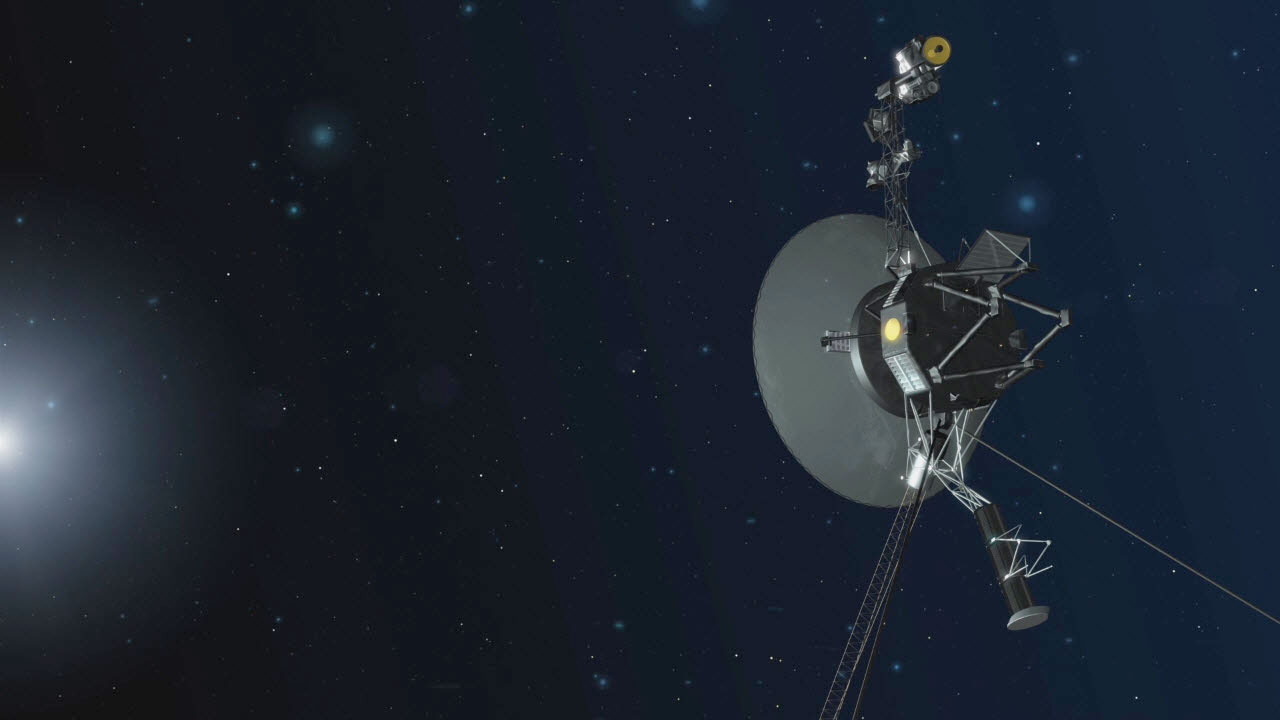
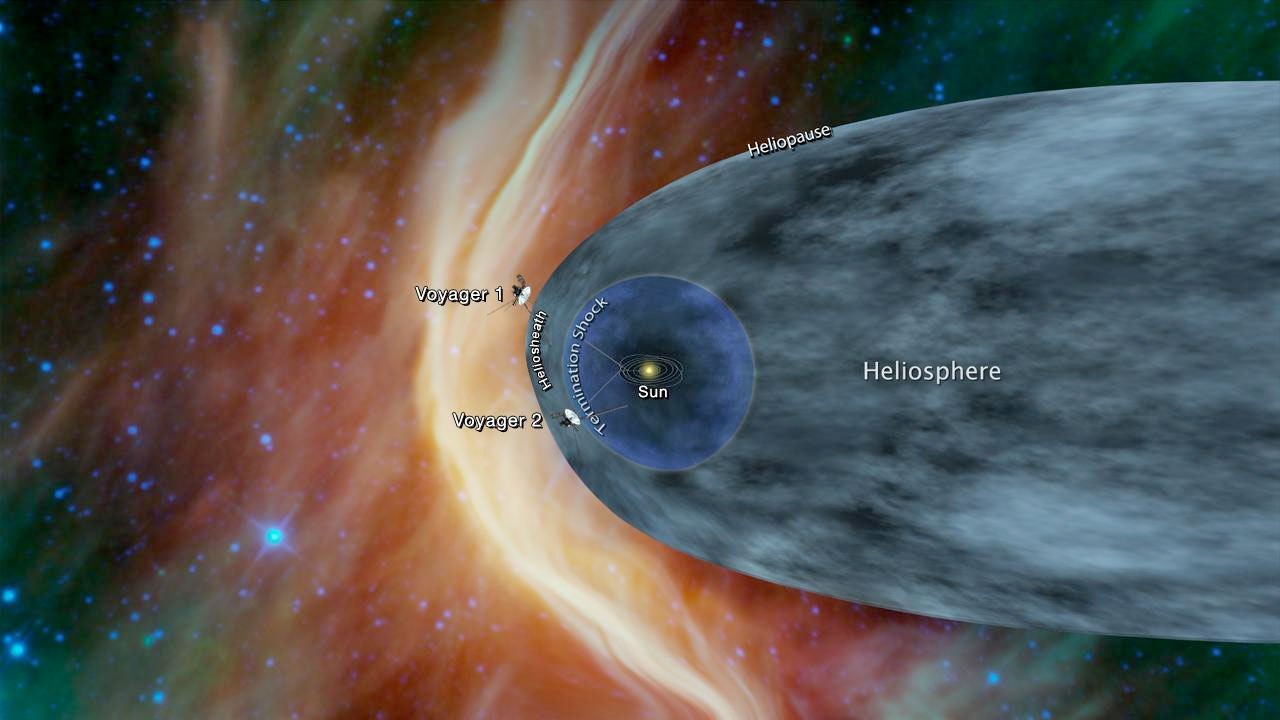
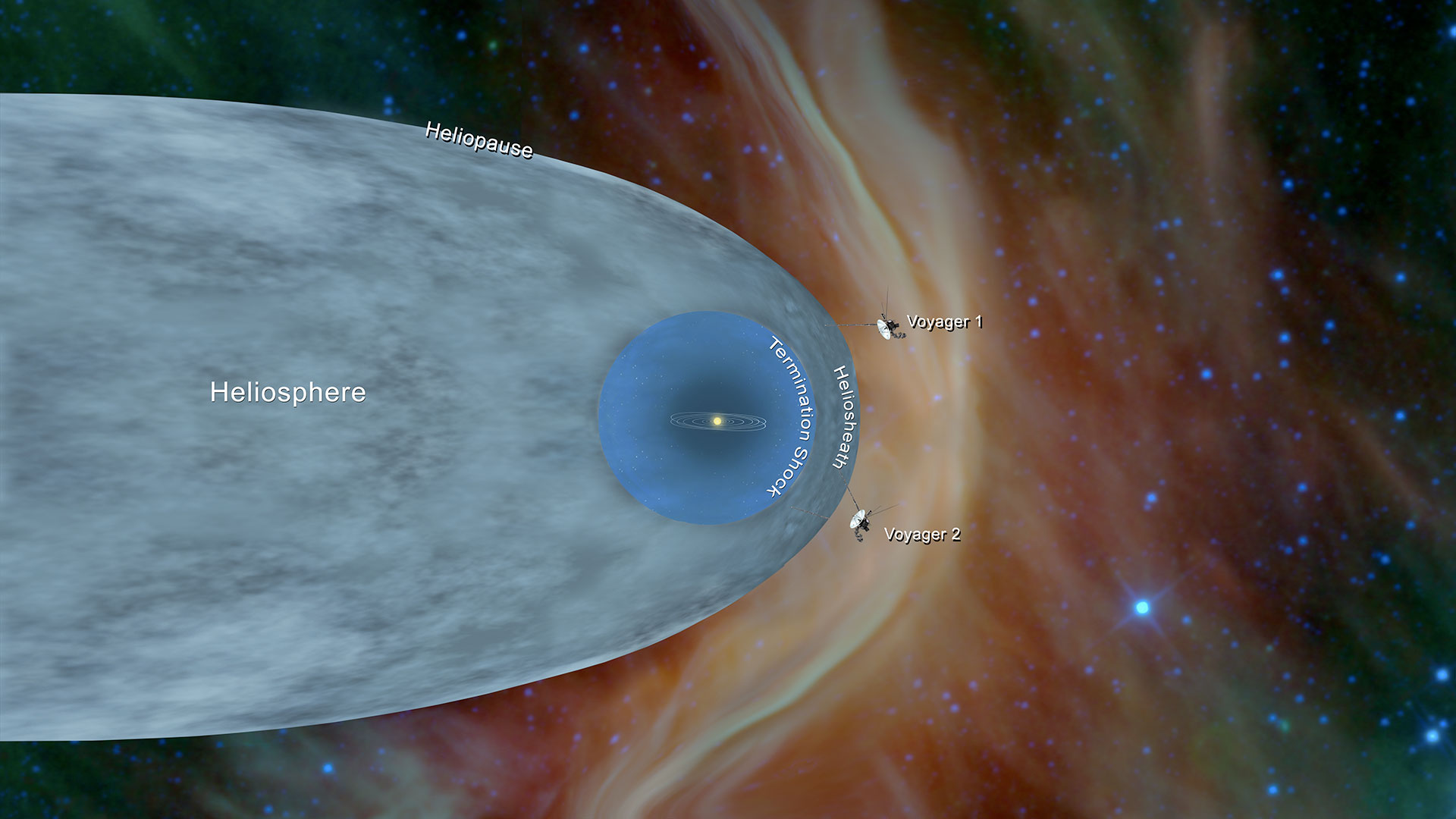
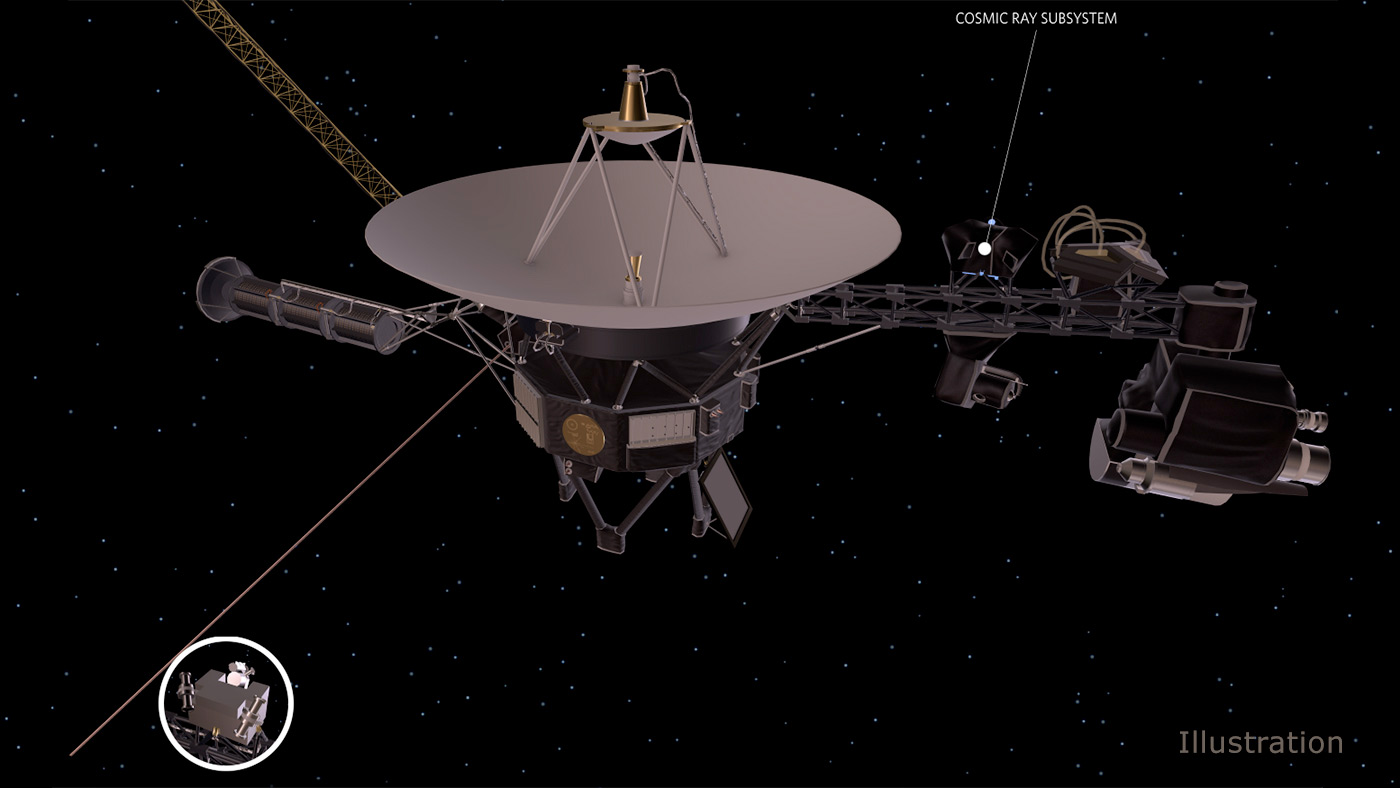
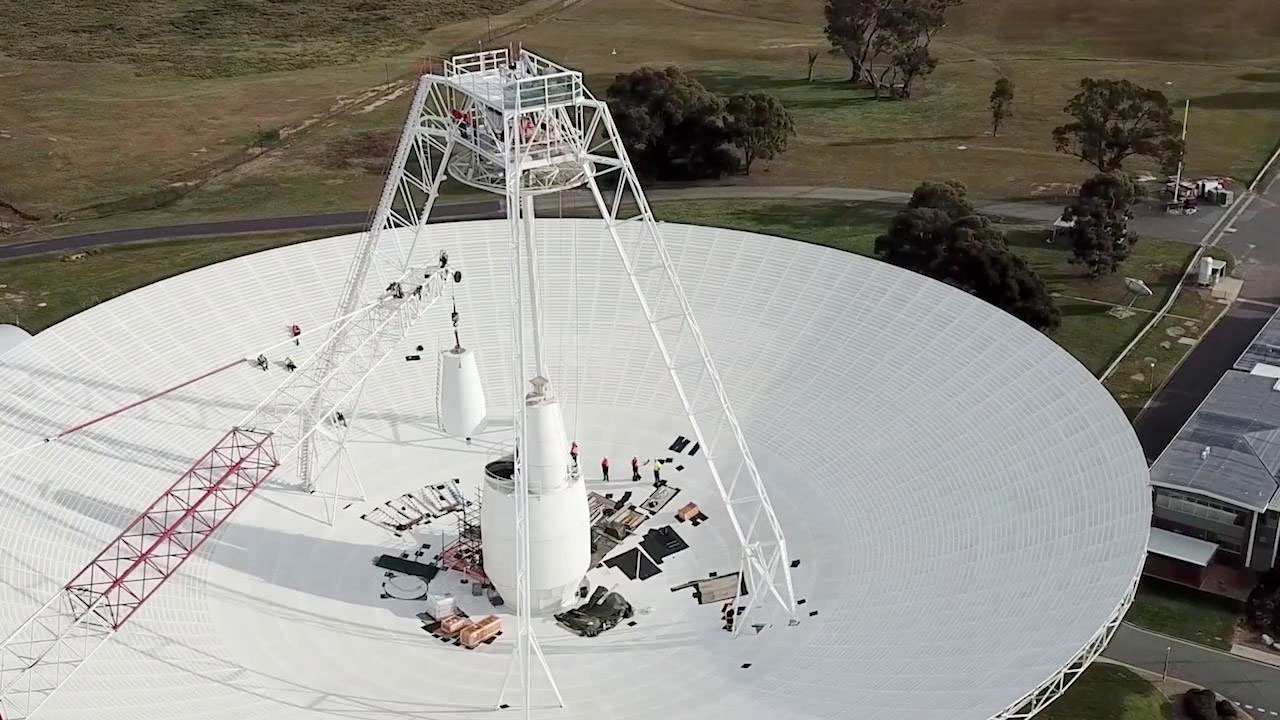


 advertisement